Skip to content
Welcome To Our Store.
100,000+ Products for Home, Medical, Office & Classroom Needs
Search
Skip to product information
1 of 1

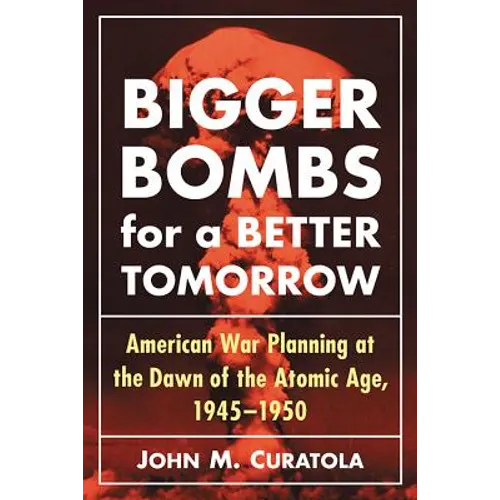
Bigger Bombs for a Brighter Tomorrow: The Strategic Air Command and American War Plans at the Dawn of the Atomic Age, 1945-1950 - Paperback

$53.91 USD
$53.91 USD
Sale Sold out
Shipping calculated at checkout.
In stock (100 units), ready to be shipped

Available Offers

Fast delivery available on most orders

Multiple secure payment options accepted

Secure checkout with
  • American Express
  • Apple Pay
  • Diners Club
  • Discover
  • Google Pay
  • Mastercard
  • PayPal
  • Shop Pay
  • Visa

Flight Range: Up to 1,000 meters (3,280 feet)

Maximum Speed: 45 kilometers per hour (28 miles per hour)

For all orders exceeding a value of 100USD shipping is offered for free.

Returns will be accepted for up to 10 days of Customer’s receipt or tracking number on unworn items. You, as a Customer, are obliged to inform us via email before you return the item.

Otherwise, standard shipping charges apply. Check out our delivery Terms & Conditions for more details.

View Product Details
Shopping cart
Product Product subtotal Quantity Price Product subtotal
Bigger Bombs for a Brighter Tomorrow: The Strategic Air Command and American War Plans at the Dawn of the Atomic Age, 1945-1950 - Paperback
$53.91/ea
$0.00
$53.91/ea $0.00

Product Description

by John M. Curatola (Author)

Right after World War II, the United States felt secure in its atomic monopoly. With the American Pax Atomica in place, the free world held an apparent strategic advantage over the Soviet bloc and saw itself as a bulwark against communist expansion. But America's atomic superiority in the early postwar years was more fiction than fact. From 1945 until 1950, the U.S. atomic arsenal was poorly coordinated, equipped and funded. The newly formed Atomic Energy Commission inherited from the Manhattan Engineer District a program suffering from poor organization, failing infrastructure and internal conflict. The military establishment and the Air Force's Strategic Air Command little knew what to do with this new weapon. The Air Force and the AEC failed to coordinate their efforts for a possible atomic air offensive and war plans were ill-conceived, reflecting unrealistic expectations of Air Force capabilities and possible political outcomes. This lack of preparedness serves as a case study in the tenuous nature of American civilian-military relationships. Instructors considering this book for use in a course may request an examination copy here.

Author Biography

John M. Curatola, a retired Marine Corps officer, is a history professor at the United States Army Command and General Staff College at Fort Leavenworth, Kansas.


Number of Pages: 236
Dimensions: 0.6 x 9 x 6 IN
Illustrated: Yes
Publication Date: February 02, 2016
you might like
