


Product Description
by Jacob Neufeld (Author)
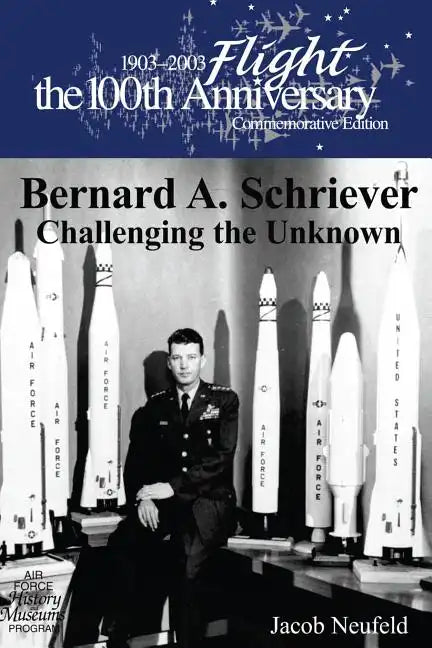
When, on June 5, 1998, Falcon Air Force Base, ten miles east of Colorado Springs, Colorado, was renamed in honor of General Bernard A. Schriever, USAF (Ret.), it marked a singular event. Normally, such an honor is bestowed posthumously, but in this case, the renaming ceremony proved the exception. Although World War II had sparked an effusion of scientific and technical developments, among them radar, electronic warfare, jet engines, air-to-air and air-to-ground missiles, and data-processing technology, the two innovations of unprecedented character that had the greatest affect on the Air Force and the world balance of power were nuclear weapons and ballistic missiles. Gen. Henry H. "Hap" Arnold, who led the Army Air Forces in World War II, believed correctly that the Air Forces' future lay in adapting scientific and engineering advances to air warfare. He was determined to continue in peacetime the cooperation between the Air Force, university scientists, and industry that had paid such handsome dividends during the war. One of the men selected to help fashion the technology of the postwar Air Force was a young colonel named Bernard Schriever, who combined some uncommon personal attributes with engineering training and combat experience. Schriever was to become the officer most closely associated with the development of ballistic missiles. Ultimately, he would be responsible for research, development, and acquisition of all new weapons used by the United States Air Force. Recognized as an unusually intelligent man, Bennie Schriever had a strong character and a precise, disciplined, but creative mind, determined to master any task he undertook, and willing to make hard decisions. He is generally known as the "father of Air Force missiles and space." United States Air Force, Office of Air Force History. 1903 - 2003 Flight: the 100th Anniversary Commemorative Edition.



