


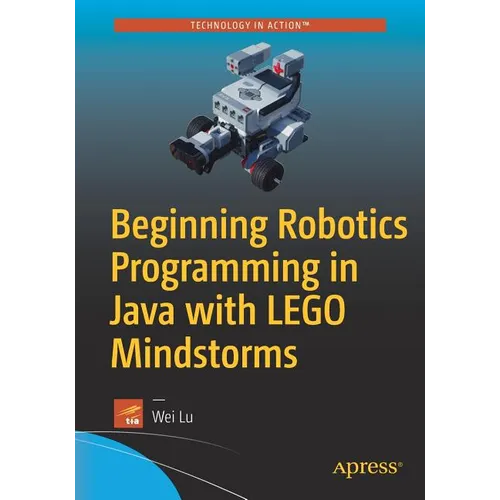
Product Description
by Wei Lu (Author)
Discover the difference between making a robot move and making a robot think.
Using Mindstorms EV3 and LeJOS--an open source project for Java Mindstorms projects--you'll learn how to create Artificial Intelligence (AI) for your bot. Your robot will learn how to problem solve, how to plan, and how to communicate. Along the way, you'll learn about classical AI algorithms for teaching hardware how to think; algorithms that you can then apply to your own robotic inspirations.
If you've ever wanted to learn about robotic intelligence in a practical, playful way, Beginning Robotics Programming in Java with LEGO Mindstorms is for you.
What you'll learn:
- Build your first LEGO EV3 robot step-by-step
- Install LeJOS and its firmware on Lego EV3
- Create and upload your first Java program into Lego EV3
- Work with Java programming for motors
- Understand robotics behavior programming with sensors
- Review common AI algorithms, such as DFS, BFS, and Dijkstra's Algorithm
Back Jacket
This book will show you the difference between making a robot move and making a robot THINK. Using Mindstorms EV3 and LeJOS, an open source project for Java Mindstorms projects, you'll learn how to create Artificial Intelligence for your bot. Your robot will learn how to problem solve, how to plan, how to learn, and how to communicate. Along the way, you'll learn about classical AI algorithms for teaching hardware how to think, algorithms that you can then apply to your own robotic inspirations.
If you've ever wanted to learn about robotic intelligence in a practical, playful way, Beginning Robotics Programming in Java with LEGO Mindstorms is for you.
Author Biography
Wei Lu is an Associate Professor of Computer Science, Keene State College, New Hampshire. He received his Ph.D. degree in Electrical and Computer Engineering from the University of Victoria. Prior to joining Keene State College, he was a Research Scientist with the German Research Centre for Artificial Intelligence and worked with Q1 Labs Inc. (Security Systems Division, IBM since October 2011) as a Secure Software Engineer. His general areas of research interests include Artificial Intelligence and Cyber Security. In the past 10 years, he had more than 40 papers published by peer-reviewed journals, book chapters, and conference proceedings. In addition, he co-authored a book, Network Intrusion Detection and Prevention: Concepts and Techniques published by Springer and has served as a technical program committee and a technical reviewer for more than 70 international conferences and journals since 2006.



