


Product Description
by Carl Rogers (Author), Mary Beck (Author)
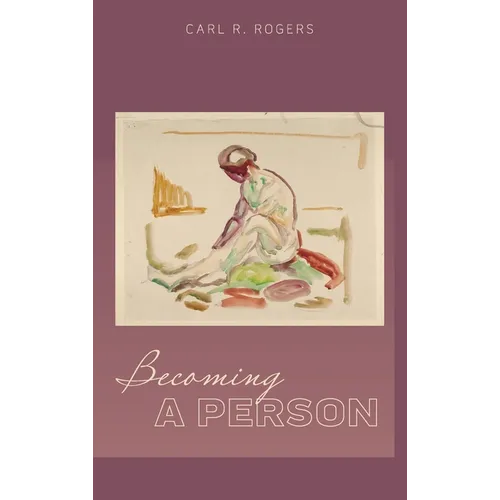
Becoming a Person, 1954
In many ways, Carl Rogers was a revolutionary. Raised in a strict, conservative home, Rogers eventually developed a theory of psychology that swept away old power structures and put the patient in charge of his own treatment. His work continues to be important for what it teaches us about relationships and human potential, as well as about psychology.
Unlike earlier practitioners of psychology, like Sigmund Freud or Carl Jung, Rogers did not elaborate a unifying theory of human consciousness. His work is not focused on unconscious drives, collective memory, or hidden impulses. It does not dwell on childhood memories or on sexuality, unless the patient (or, to use Rogers' own word, the client) wants to dwell on those matters.
Instead, Rogers focused on what he called the desire for self-actualization. He believed that by creating the right conditions, therapy could release people from whatever was holding them back so that they could discover their true selves and live in harmony with the world around them.
Rogers is probably best known for developing what he called nondirective, or client-centered therapy. He argued that people were innately good and possessed the ability to heal themselves, even when they had become seriously disconnected from reality. However, this sort of healing couldn't occur in a vacuum. Rogers stressed the importance of therapeutic relationships to give people the confidence and freedom to develop, so that they could achieve their true potential.
Rogers assigned therapists a different role than the one they'd traditionally had. Traditionally, analysts had taken a fairly active role in their patients' treatment, offering their opinions on patients' needs and progress. Under Rogers' system, though, therapists took on a more passive position. Rather than diagnosing their patients or presenting a treatment plan, therapists focused on creating an atmosphere of warmth, safety, and acceptance.
Rogers' ideal therapist was not a detached authority figure, taking notes while his patient poured out his earliest childhood memories. Rather, Rogers wanted therapists to enter into a genuine relationship with their clients. This would give clients the space they needed to drop their masks and gradually confront their true personhood.
Careful readers will notice that Rogers was influenced by the likes of Soren Kierkegaard, especially when it came to the ongoing search for self. Rogers quotes Kierkegaard as saying, "to will to be that self which one truly is, is indeed the opposite of despair."
Becoming a Person builds on that idea-the search for the self in combination with the quest for happiness-and applies it to the central problem of the psychologist, namely, what to do when faced with a troubled, conflicted person who is seeking and expecting help. For Rogers, each patient has the same problem-who am I, really? How can I become myself? The successful psychologist can help his clients to answer that question.
Number of Pages: 36
Dimensions: 0.25 x 9 x 6 IN
Publication Date: March 23, 2022