Product Description
by Herman Melville (Author)
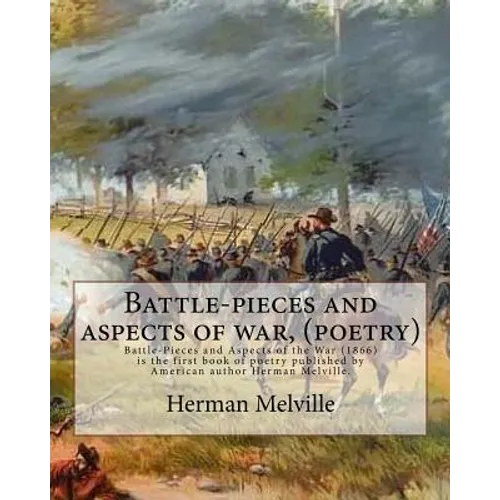
Battle-Pieces and Aspects of the War (1866) is the first book of poetry published by American author Herman Melville. The volume is dedicated "To the Memory of the Three Hundred Thousand Who in the War For the Maintenance of the Union Fell Devotedly Under the Flag of Their Country" and its 72 poems deal with the battles and personalities of the American Civil War and their aftermath. Also included are Notes and a Supplement in prose in which Melville sets forth his thoughts on how the Reconstruction should be carried out. Critics at the time were at best respectful and often sharply critical of Melville's unorthodox style. The book had sold only 486 copies by 1868 and recovered barely half of its publications costs.Not until the latter half of the twentieth century did Battle-Pieces become regarded as one of the most important group of poems on the American Civil War.The poems and their background The book is Melville's return to poetry after a hiatus which began in 1860 when Harper & Brothers turned down a book of his poems, which is now lost. After moving his family from Massachusetts to New York in 1863, Melville contemplated writing a book of poems on the war, but evidently did not begin to do so until 1864.The book was not published until 1866, a year after the end of the war. The title refers to the familiar paintings by Dutch and British artists who depicted scenes of battle at sea and musical settings of these battles. Melville's major source for the poems were the early volumes of Frank Moore's (compiler) eleven-volume The Rebellion Record: A Diary of American Events, with Documents, Narratives, Illustrative Incidents, Poetry, Etc. (New York: G.P. Putnam, 1861-1868).Battle-Pieces is made up of 72 short lyric and narrative poems grouped into two sections. The first and longer sequence is centered on battles, but the emphasis is on taking stock of the results and on the personalities of the officers who led them. The second, shorter series is made up of elegies, epitaphs, and requiems.....The opening poem is "The Portent," a meditation on the hanging of the abolitionist John Brown: Hanging from the beam, Slowly swaying (such the law), Gaunt the shadow on your green, Shenandoah The cut is on the crown (Lo, John Brown), And the stabs shall heal no more. Hidden in the cap Is the anguish none can draw; So your future veils its face, Shenandoah But the streaming beard is shown (Weird John Brown), The meteor of the war. Other poems include: "A Requiem For Soldiers Lost In Ocean Transports"; "The Martyr Indicative of the Passion of the People on the 15th of April 1865"; "The Frenzy In The Wake Sherman's Advance Through The Carolinas"; "The March To The Sea"; "Look-Out Mountain The Night Fight"; "Shiloh A Requiem"; "A Utilitarian View Of The Monitor's Fight"; "The Conflict Of Convictions"; "On the Slain at Chickamauga." In the prose "Supplement," Melville says that he is "one who never was a blind adherent," and advocates reconciliation with the South. He does not favor enfranchising former slaves immediately, for they are "in their infant pupilage to freedom" and argues that sympathy for them "should not be allowed to exclude kindliness to communities who stand closer to us in nature." He continues, "Let us be Christians toward our fellow-whites, we well as philanthropists toward the blacks, our fellow-men." Lawrence Buell notes that Melville wrote from a Yankee viewpoint but that Battle-Pieces seldom voices jingoism or triumphalism... Herman Melville (August 1, 1819 - September 28, 1891) was an American novelist, short story writer, and poet of the American Renaissance period. His best known works include Typee (1846), a romantic account of his experiences in Polynesian life, and his whaling novel Moby-Dick (1851). .........