


Product Description
by Peter Schuck (Author), Huaying Zhao (Author), Chad A. Brautigam (Author)
Analytical ultracentrifugation (AUC) can supply rich information on the mass, shape, size distribution, solvation, and composition of macromolecules and nanoscopic particles. It also provides a detailed view of their reversible single- or multi-component interactions over a wide range of affinities. Yet this powerful technique has been hard to master in mainstream molecular sciences due to a lack of comprehensive books on the subject.
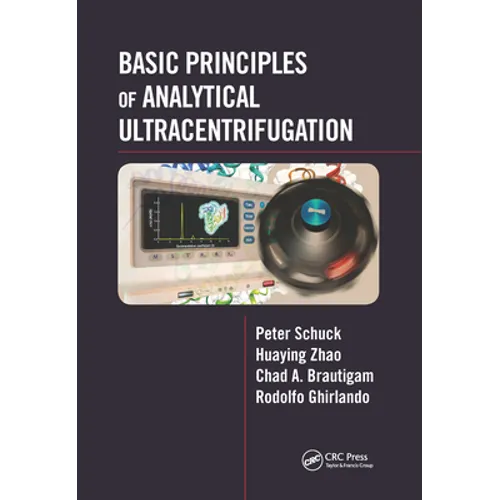
Filling this gap in the literature of biophysical methodology, Basic Principles of Analytical Ultracentrifugation explains the fundamentals in the theory and practice of AUC. The book provides you with up-to-date experimental information to confidently practice AUC. You will understand the basic concepts, full potential, and possible pitfalls of AUC as well as appreciate the current relevance of past work in the field.
The book first introduces the basic principles and technical setup of an AUC experiment and briefly describes the optical systems used for detection. It then explores the ultracentrifugation experiment from a macromolecular standpoint, offering a detailed physical picture of the sedimentation process and relevant macromolecular parameters. The authors present important practical aspects for conducting an experiment, including sample preparation, data acquisition and data structure, and the execution of the centrifugal experiment. They also cover instrument calibration and quality control experiments.
Author Biography
Peter Schuck is an Earl Stadtman Tenure‐Track Investigator and Chief of the Dynamics of Macromolecular Assembly Section in the Laboratory of Cellular Imaging and Macromolecular Biophysics at the National Institute of Biomedical Imaging and Bioengineering, U.S. National Institutes of Health. He obtained his Ph.D. from the Goethe‐University Frankfurt am Main, where he worked on interactions of integral proteins of the erythrocyte membrane using analytical ultracentrifugation.
Huaying Zhao is a Staff Scientist in the Dynamics of Macromolecular Assembly Section in the Laboratory of Cellular Imaging and Macromolecular Biophysics at the National Institute of Biomedical Imaging and Bioengineering, U.S. National Institutes of Health. She received a Ph.D. in chemistry from the University of Mississippi, with a specialization in protein biochemistry. Her main research interests are the development of biophysical methodology for characterizing a variety of macromolecules, including proteins, nucleic acids, polymers, and nanoparticles.
Chad A. Brautigam is an Associate Professor in the Department of Biophysics at The University of Texas Southwestern Medical Center. He earned a Ph.D. in biophysics from Yale University. His research focuses on the structures and functions of lipoproteins of pathogenic bacteria. He is also interested in improving the analysis and presentation of biophysical data.
Rodolfo Ghirlando is a Staff Scientist in the Laboratory of Molecular Biology at the National Institute of Diabetes and Digestive and Kidney Diseases, U.S. National Institutes of Health. He earned his Ph.D. from the Weizmann Institute of Science. His research interests include the study of the in vivo chromatin structure at the 30‐nm fiber level and, more generally, the development of hydrodynamic methodology for the study of challenging biomacromolecular interactions.



