Product Description
by Edward S. Miller (Author)
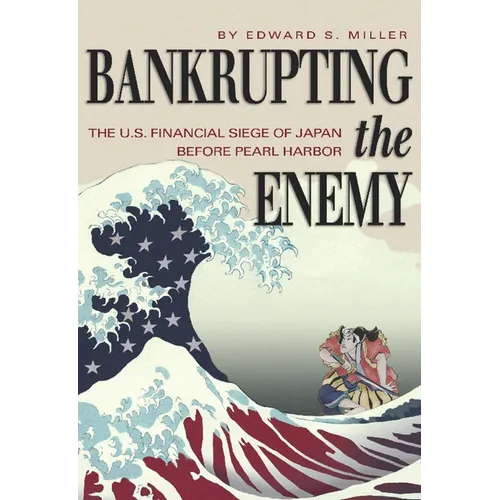
Award-winning author Edward S. Miller contends in this work that the United States forced Japan into international bankruptcy to deter its aggression. While researching newly declassified records of the Treasury and Federal Reserve, Miller, a retired chief financial executive of a Fortune 500 resources corporation, uncovered just how much money mattered. Washington experts confidently predicted that the war in China would bankrupt Japan, not knowing that the Japanese government had a huge cache of dollars fraudulently hidden in New York. Once discovered, Japan scrambled to extract the money. But, Miller explains, in July 1941 President Roosevelt invoked a long-forgotten clause of the Trading with the Enemy Act of 1917 to freeze Japan's dollars and forbade it to sell its hoard of gold to the U.S. Treasury, the only open gold market after 1939. Roosevelt's temporary gambit to bring Japan to its senses, not its knees, was thwarted, however, by opportunistic bureaucrats. Dean Acheson, his handpicked administrator, slyly maneuvered to deny Japan the dollars needed to buy oil and other resources for war and for economic survival. Miller's lucid writing and thorough understanding of the complexities of international finance enable readers unfamiliar with financial concepts and terminology to grasp his explanation of the impact of U.S. economic policies on Japan. His review of thirty-seven studies of Japan's resource deficiencies begs the question of why no U.S. agency calculated the impact of the freeze on Japan's overall economy. His analysis of a massive OSS-State Department study of prewar Japan clearly demonstrates that the deprivations facing the Japanese people were the country to remain in financial limbo buttressed its choice of war at Pearl Harbor. Such a well-documented study is certain to be recognized for its significant contributions to the historiography of the origins of the Pacific War.
Author Biography
Edward S. Miller, a Phi Beta Kappa graduate in economics at Syracuse University and the Harvard Advanced Management Program, served as chief financial officer of a major international mining corporation and the U.S. Synthetic Fuels Corporation.