Product Description
by Éric Monnet (Author), Steven Rendall (Translator)
Central banks now stand between societies and collapse, but are they still democratic?
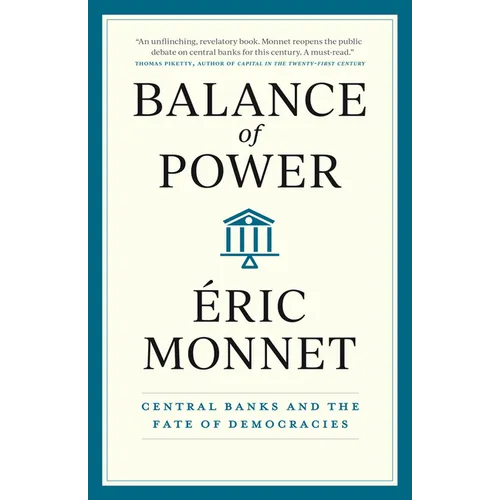
Two decades of financial crises have dramatically expanded central banks' powers. In 2008, and then again in 2020, unelected banking officials found themselves suddenly responsible for the public welfare--not just because it was necessary but based on an idea that their independence from political systems would insulate them from the whims of populism. Now, as international crises continue and the scope of monetary interventions grows in response, these bankers have become increasingly powerful. In Balance of Power, economist and historian Éric Monnet charts the rise of central banks as the nominally independent--but unavoidably political--superpowers of modern societies. This trajectory, Monnet argues, is neither inevitable nor unstoppable. By embracing the political natures of today's central banks, we can construct systems of accountability for how they interact with states and societies. Monnet shows that this effort will do more than guard against unjust power; it will put the banks to work for greater, more democratic ends. With existential challenges looming and the work of the Federal Reserve and European Central Bank more important than ever, Balance of Power offers a trenchant case for what this century's central banks can--and must--become.Author Biography
Éric Monnet is professor at the Paris School of Economics and director of studies at the School of Advanced Studies in the Social Sciences, Paris. He was named France's best young economist by Le Monde in 2022. Steven Rendall is professor emeritus of romance languages at the University of Oregon. He has translated more than eighty books into English.
Number of Pages: 264
Dimensions: 0.8 x 8.6 x 5.5 IN
Publication Date: April 29, 2024