


Product Description
by MD Lawrence Broxmeyer (Author)
KIRKUS REVIEWS
TITLE INFORMATION
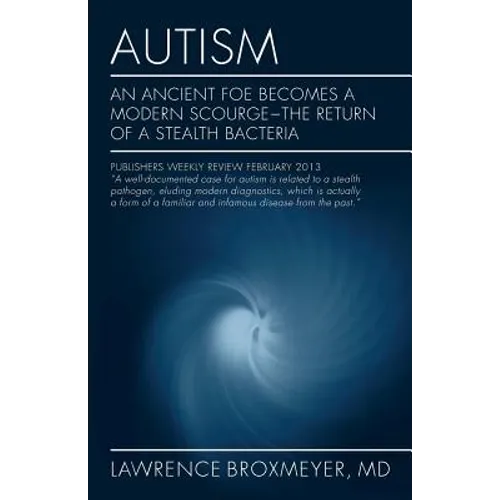
AUTISM
An Ancient Foe Becomes a Modern Scourge - The Return of a Stealth Bacteria
Broxmeyer, Dr. Lawrence
CreateSpace (180 pp.)
$8.95 paperback
ISBN: 978-1478101260; November 14, 2012
BOOK REVIEW
"Autism has proved to be one of the more haunting medical mysteries of recent times. As the diagnosis rate explodes, desperate parents and baffled doctors have searched in vain for an explanation. Broxmeyer, an internist and experienced medical researcher who's studied both AIDS and Alzheimer's disease, offers a new perspective. His book focuses on an underresearched link between autism and fetal exposure to tuberculosis bacteria. The hypothesis is a fascinating one, and Broxmeyer provides evidence from enough esteemed researchers to give credence to his ideas."
The consensus that autism is from an intrauterine infection is growing, bolstered by Patterson's and Fatemi's studies. However, the question still unanswered remains: which infection? This of course is unknown. But in Autism: An Ancient Foe, a prime, conceivable candidate is logically presented, and compellingly supported by scientific literature, old and new. Until 1980 autism is called "childhood schizophrenia" and in some parts of the world, it still is. By the same token, an extensive body of medical literature ties schizophrenia to mycobacterial disease, the infectious focus of this book. This was only brought more sharply into focus when Rzhetsky, in 2007, used a proof-of-concept biostatistical analysis of 1.5 million patient records, to find significant genetic overlap in humans with autism, schizophrenia........and tuberculosis. To this effect NIMH trials, presently ongoing, will determine whether the anti-tubercular drug Seromycin helps to diminish the symptomatology of autism as it did in animal models.
In a sense, this connection is hardly a new one. As early as the 1887s, John Langdon Down, a subset of whose "developmentally disabled" children were autistic, saw this infection "for the most part" as resulting from parental tuberculosis.
Ann Arbor pathologist A.S. Warthin, appearing in The Journal of Infectious Diseases, suggested that even a woman with silent foci of tuberculosis in her body, and with no symptoms could experience reactivation of her disease upon becoming pregnant. That, in turn, could transmit blood-borne TB bacilli to her unborn child. In fact, Warthin emphasized, this sort of transmission was not only possible, but common. Warthin saw silent assymtomatic tuberculosis during pregnancy as a "very grave danger" to the fetus and-as J.F. Schoeman would later argue-it could cause the sort of neonatal brain lesions that lay behind all neurodevelopmental disorders, including autism.
But TB has been "eradicated," right? Hardly, Broxmeyer explains. While tuberculosis is not generally regarded in the West as the killer disease it once was, according to the World Health Organization, TB presently affects over one-third of the world's inhabitants. Even in the twenty-first century, globally, at least one person is infected with tuberculosis per second, and someone dies of TB every ten seconds. Tuberculosis kills 2-3 million people each year, more than any other infectious disease in the world.
Eight years in the making, An Ancient Foe is a short and fascinating read that is equal parts science, history, and whodunit. Broxmeyer's meticulously-documented biography of the disease weaves back and forth in time and place like a Ken Burns film edited by Tarantino. Readers leap from the modern day back to the 1800s, forward to the 1930s, and then back again as Broxmeyer spins his tale and makes his case. Along the way, he explores the little-known historic connection between autism, schizophrenia, and tuberculosis, and explains in layman's terms the complex series of steps, missteps, and steps-left-untaken that have allowed autism's "stealth pathogen" to evade modern diagnostics for dec
Author Biography
Lawrence Broxmeyer, MD is currently a Pennsylvania internist and a medical researcher. Dr. Broxmeyer's research covers the most challenging medical problems of our times, including AIDS, Alzheimer's, and now autism. Broxmeyer served on staff at New York-affiliate hospitals-SUNY Downstate, Cornell, and New York University-for nearly fifteen years. In the role of lead author and originator, he worked with colleagues in San Francisco and at the University of Nebraska to pioneer a novel technique for killing AIDS mycobacteria and tuberculosis-with outstanding results (see The Journal of Infectious Diseases, 2002 Oct 15). Recently, he contributed a chapter regarding these findings to Sleator and Hill's textbook, Patho-Biotechnology, published by Landes Bioscience. His peer-reviewed articles are available on PubMed of The US Library of Medicine-National Institutes of Health at: http: //www.ncbi.nlm.nih.gov/pubmed?term=broxmeyer%20L



