


Product Description
by Zachary Keck (Author)
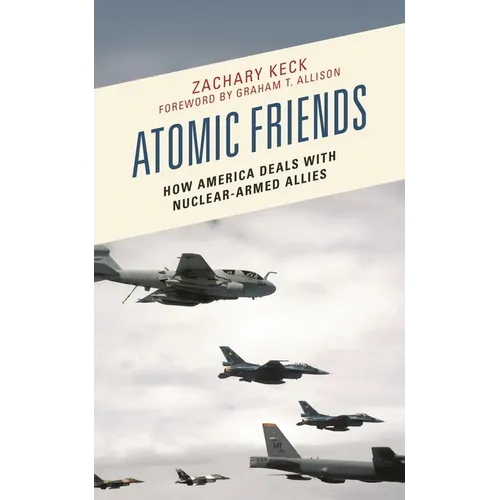
Should the United States prevent additional allies from developing atomic weapons? Although preventing U.S. allies and partners from acquiring nuclear weapons was an important part of America's Cold War goals, in the decades since, Washington has mostly focused on preventing small adversarial states from building the bomb. This has begun to change as countries as diverse as Germany, Japan, South Korea, Turkey, and Saudi Arabia, among others, have begun discussing the value of an independent nuclear arsenal. Their ambitions have led to renewed discussion in U.S. foreign policy circles about the consequences of allied proliferation for the United States. Even though four countries have acquired nuclear weapons, this discussion remains abstract, theoretical, and little changed since the earliest days of the nuclear era.
Using historical case studies, this book shines a light on this increasingly pressing issue. Keck examines the impact that acquiring nuclear arsenals had after our allies developed them. He examines existing and recently declassified documents, original archival research, and--for the Israel and especially Pakistan cases--interviews with U.S. officials who worked on the events in question.Author Biography
Zachary Keck has worked on nuclear issues across government, think tanks, and media. In Congress, he was a Professional Staff Member for the House Foreign Affairs Committee, including for the Subcommittee on Nonproliferation. Keck has also worked as a researcher at the Belfer Center for Science and International Affairs at the Harvard Kennedy School and the Nonproliferation Policy Education Center. He began his career in media, working as the Managing Editor of The Diplomat and The National Interest. Keck has published over 1,000 articles including in the Wall Street Journal, The Atlantic, CNN.com, Foreign Affairs, Foreign Policy, and The Bulletin of Atomic Scientists. You can find him on Twitter: @ZacharyKeck.