Skip to content
Welcome To Our Store.
100,000+ Products for Home, Medical, Office & Classroom Needs
Search
Skip to product information
1 of 1

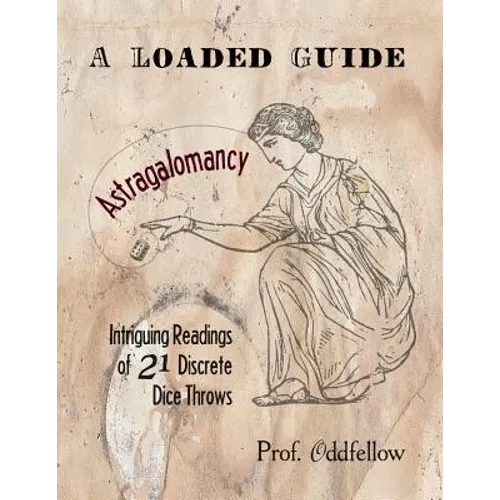
Astragalomancy: A Loaded Guide: Intriguing Readings of 21 Discrete Dice Throws - Paperback

$19.10 USD
$19.10 USD
Sale Sold out
Shipping calculated at checkout.
In stock (100 units), ready to be shipped

Available Offers

Fastest Delivery Tomorrow With Vip DealOrder within 1 hr 8 mins.

Instant 10% Discount On HDFC Banks Credit/Debit Cards EMI and CreditCard

Secure checkout with
  • American Express
  • Apple Pay
  • Diners Club
  • Discover
  • Google Pay
  • Mastercard
  • PayPal
  • Shop Pay
  • Visa

Flight Range: Up to 1,000 meters (3,280 feet)

Maximum Speed: 45 kilometers per hour (28 miles per hour)

For all orders exceeding a value of 100USD shipping is offered for free.

Returns will be accepted for up to 10 days of Customer’s receipt or tracking number on unworn items. You, as a Customer, are obliged to inform us via email before you return the item.

Otherwise, standard shipping charges apply. Check out our delivery Terms & Conditions for more details.

View Product Details
Shopping cart
Product Product subtotal Quantity Price Product subtotal
Astragalomancy: A Loaded Guide: Intriguing Readings of 21 Discrete Dice Throws - Paperback
$19.10/ea
$0.00
$19.10/ea $0.00

Product Description

by Craig Conley (Author), Prof Oddfellow (Author)

There is perhaps no better way to conjure up the spirit of great antiquity than to roll dice. The very ancient game of throwing knucklebones dates back to the Trojan War (ca. 1194-1184 BCE), if we are to take Sophocles' word. The original knucklebone was technically a bone in a sheep's ankle, the astragalus, hence divination by astragalomancy.

The great Greek philosopher Plato traced dice even farther back, to the ibis-headed Egyptian god Thoth, inventor of magic and writing and science, divine arbitrator, judge of the dead, and maintainer of the universe. Plato himself played dice not only with cubes but also tetrahedrons, octahedrons, dodecahedrons, and icosahedrons-the famous "Platonic solids" of geometry. Plato said, "God geometrizes," and that's a key to why dice have always been associated with divination-the geometric solids, as building blocks of the universe, embody truths on higher planes.

Over the centuries, several rules have been associated with throwing dice for divination. "However, it is entirely a matter of personal choice whether these are followed or ignored. Many of these rules are arbitrary and were probably developed to add mystery and significance to divination by dice. Do not be afraid to develop your own guidelines, nor to be completely spontaneous, using the dice in different ways according to your instincts at the time. Trusting your instincts is the best way to get a good reading."


Number of Pages: 36
Dimensions: 0.07 x 11 x 8.5 IN
Publication Date: June 30, 2012
you might like
