Product Description
by Aban Haq (Author), Mehnaz Safavian (Author)
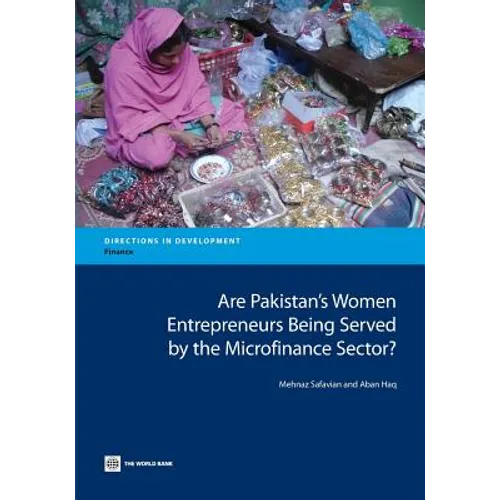
"Financial services are important for women who are starting and growing a business, but in Pakistan microfinance providers (MFPs) are not reaching Pakistan's businesswomen. Only 59 percent of microfinance clients are women, yet the majority of these loans are passed on the male members of the household - husbands, fathers, and sons. The practice of passing on loans to male household members is quite widespread; women may be bearing all the transaction costs and risks of accessing loans, but are not the final beneficiaries. Second, a very low proportion of female microfinance clients are entrepreneurs. The report explores why businesswomen in Pakistan may not be using microfinance products to meet their start-up and working capital requirements, in spite of identifying access to finance as a key constraint to their business operations. Against this backdrop, access to finance remains the biggest challenge for a woman who wants to start or grow a business. Yet less than a quarter of the entrepreneurs identified through business development service providers were currently borrowing from microfinance lenders. Even among those entrepreneurs that borrow, dissatisfaction is high. Why? Women borrower-entrepreneurs are not able to access individual loan products, but instead are consistently relegated to group lending. But group loans are very costly for a woman who is running a business, and the loans are too small to fulfill working capital needs. Businesswomen are rarely given the opportunity to access individual loan products, which are usually offered exclusively to male borrowers, and women are not given opportunities to graduate from group loans to individual loans over time. Lending practices often are discriminatory, requiring husbands' permission, male guarantors, and unmarried women are rarely considered as potential clients. Although MFIs understand that women's inclusion is integral to the objectives of microfinance, the practice of passing on loans raises serious issues about consumer protection for women clients, and the best and most effective solutions to these challenges could and should come from the sector itself. Designing better products that reach the needs of emerging women entrepreneurs could prove to be good business, achieving double bottom-line objectives. Investing in financial literacy and education of both men and women borrowers can help curb the demand for pass-through loans and help lower risks associated with deceptive practices."