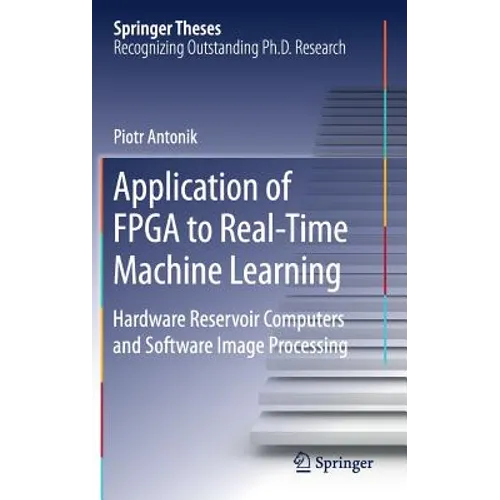
Product Description
by Piotr Antonik (Author)
This book lies at the interface of machine learning - a subfield of computer science that develops algorithms for challenging tasks such as shape or image recognition, where traditional algorithms fail - and photonics - the physical science of light, which underlies many of the optical communications technologies used in our information society. It provides a thorough introduction to reservoir computing and field-programmable gate arrays (FPGAs).
Recently, photonic implementations of reservoir computing (a machine learning algorithm based on artificial neural networks) have made a breakthrough in optical computing possible. In this book, the author pushes the performance of these systems significantly beyond what was achieved before. By interfacing a photonic reservoir computer with a high-speed electronic device (an FPGA), the author successfully interacts with the reservoir computer in real time, allowing him to considerably expand its capabilities and range of possible applications. Furthermore, the author draws on his expertise in machine learning and FPGA programming to make progress on a very different problem, namely the real-time image analysis of optical coherence tomography for atherosclerotic arteries.
Back Jacket
This book lies at the interface of machine learning - a subfield of computer science that develops algorithms for challenging tasks such as shape or image recognition, where traditional algorithms fail - and photonics - the physical science of light, which underlies many of the optical communications technologies used in our information society. It provides a thorough introduction to reservoir computing and field-programmable gate arrays (FPGAs).
Recently, photonic implementations of reservoir computing (a machine learning algorithm based on artificial neural networks) have made a breakthrough in optical computing possible. In this book, the author pushes the performance of these systems significantly beyond what was achieved before. By interfacing a photonic reservoir computer with a high-speed electronic device (an FPGA), the author successfully interacts with the reservoir computer in real time, allowing him to considerably expand its capabilities and range of possible applications. Furthermore, the author draws on his expertise in machine learning and FPGA programming to make progress on a very different problem, namely the real-time image analysis of optical coherence tomography for atherosclerotic arteries.
Author Biography
Piotr Antonik was born in 1989 in Minsk, Belarus. He received his Master's degree and his PhD in physics from the Université libre de Bruxelles, Brussels, Belgium, in 2013 and 2017, respectively. He is currently a post-doctoral researcher at the LMOPS Lab, CentraleSupélec, Metz, France. His research interests include spatial and time-delay photonic implementations of reservoir computing, FPGA programming, online learning methods, and applications of machine learning to biomedical imaging.