Product Description
by NASA (Author)
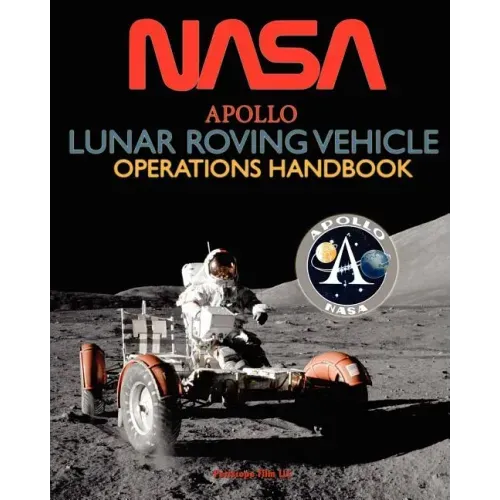
Developed in only 17 months at a cost of 38 million dollars, the Lunar Roving Vehicle (LRV) greatly expanded the survey range of the astronauts on Apollo 15, 16 and 17. Designed to operate in the low-gravity vacuum of the Moon, the LRV boasted an ingenious design that allowed it to be folded up and stored inside the Lunar Module. It would then be deployed using a system of pulleys and brake reels. The LRV's frame was made of aluminum alloy 2219 tubing assemblies, giving the vehicle a fairly small mass of 210kg but allowing it to carry up to 490kg on the lunar surface. The LRV's lightweight tires were made of zinc-coated steel strands with titanium chevrons and aluminum hubs, and offered a ground clearance of 36cm. The LRV featured two side-by-side, foldable seats, a TV camera, and a dish antenna. Four independent DC motors - one for each wheel - powered by two 36-volt batteries provided maneuvering power. Both sets of wheels could be used to steer, although they could also be decoupled. For safety reasons, astronauts never drove the LRV a distance farther from the LM than they could safely walk in the unlikely event that the rover failed. On each of the three day missions that it was employed, the LRV was used daily for three traverses. The longest was on Apollo 17, when it was driven 20.1km, and it traveled a total of 35.9km on that mission. The total distance traveled by all three LRVs was 90.4km. Almost all of it was done without incident, although some damage to the fender extensions caused dust problems on Apollo 16 and 17. Harrison Schmitt of Apollo 17 praised the design and operation of the vehicle, saying "...the Lunar Rover proved to be the reliable, safe and flexible lunar exploration vehicle we expected it to be." Originally created for the astronauts by prime contractor Boeing, this Lunar Roving Vehicle Operations Handbook describes the LRV and its systems, and details the deployment and driving procedures. It also details the 1-gravity LRV used to train astronauts on Earth. A lengthy appendix provides performance and other data.