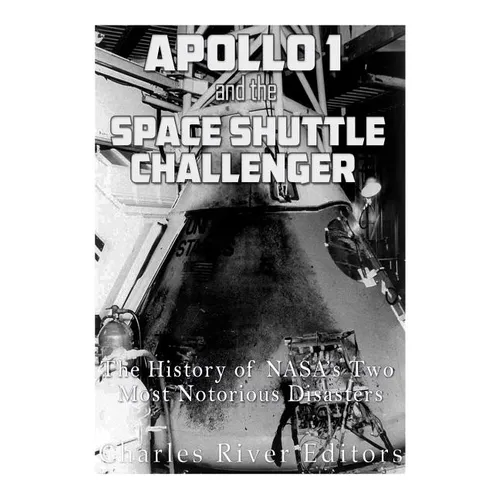
Product Description
by Charles River (Author)
*Includes pictures *Includes accounts of the disasters and government reports about them *Includes online resources and a bibliography for further reading The Apollo space program is the most famous and celebrated in American history, but the first successful landing of men on the Moon during Apollo 11 had complicated roots dating back over a decade, and it also involved one of NASA's most infamous tragedies. Landing on the Moon presented an ideal goal all on its own, but the government's urgency in designing the Apollo program was actually brought about by the Soviet Union, which spent much of the 1950s leaving the United States in its dust (and rocket fuel). In 1957, at a time when people were concerned about communism and nuclear war, many Americans were dismayed by news that the Soviet Union was successfully launching satellites into orbit. On May 25, 1961, President John F. Kennedy addressed Congress and asked the nation to "commit itself to achieving the goal, before this decade is out, of landing a man on the Moon and returning him safely to the Earth." Given America's inability to even put a man in orbit yet, this seemed like an overly ambitious goal, and it isn't even clear that Kennedy himself believed it possible; after all, he was reluctant to meet NASA Administrator James E. Webb's initial funding requests. As Apollo 11's name suggests, there were actually a number of Apollo missions that came before, many of which included testing the rockets and different orbital and lunar modules in orbit. In fact, it wasn't until Apollo 8 that a manned vehicle was sent towards the Moon and back, and before that mission, the most famous Apollo mission was Apollo 1, albeit for all the wrong reasons. There were no delusions regarding the dangers of manned space travel, but they were brought home on January 27, 1967, when all three astronauts were killed by a fire that ignited in the cabin during a launch rehearsal. To this day, there is still debate over what ignited the fire, but the disaster made clear that the modules being used by NASA had a series of fatal flaws. In the decades after the Apollo program, American space shuttles flew over 130 missions and successfully completed over 98% of them, but unfortunately, the two most famous missions were the ones that ended tragically aboard the Challenger and Columbia. The Space Shuttle Challenger was the most heavily used space shuttle in the three years it was operational, carrying the first minority astronaut and woman astronaut into space. Challenger was also the first space shuttle to complete a landing at night. On the morning of January 28, 1986, the Space Shuttle Challenger launched for the 10th time, beginning mission STS-51-L. Space shuttles had already successfully completed 24 missions, and no American spacecraft had ever failed to reach orbit during an official mission. Ascent seemed to be going normally during the first minute, but about 75 seconds into the ascent, a plastic O-ring used to seal a joint in one of the solid rocket boosters failed, causing a breach of hot gas. That gas spread to the other rocket booster and the external fuel tank, causing an explosion. When the spectators saw the explosion, many of them started cheering, unaware of what was really happening. But Mission Control quickly announced that there had been some sort of problem, and the crowd became confused and then panicky as the space shuttle, fuel tank and rocket boosters all broke apart and flew in opposite directions. Some cameras fixed on the falling debris as it fell to the ocean. The entire crew was killed in the explosion, and investigations concluded that they may have survived until crashing into the ocean. After the Challenger disaster, the space shuttles were grounded for about two years, and a commission issued findings that would be used in an effort to prevent similar tragedies.