


Product Description
by Anna T. Litovkina (Author), Hrisztalina Hrisztova-Gotthardt (Author), P騁er Barta (Author)
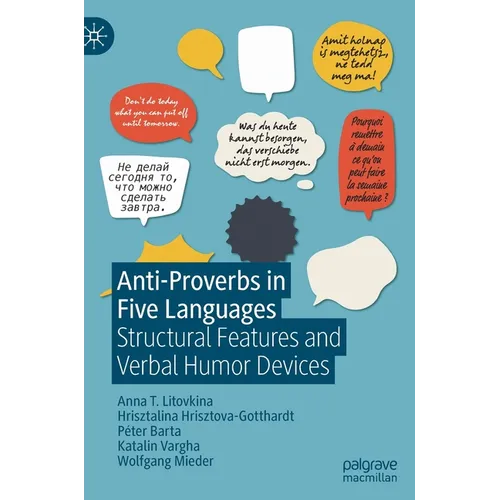
This book is the first comparative study of English, German, French, Russian and Hungarian anti-proverbs based on well-known proverbs. Proverbs are by no means fossilized texts but are adaptable to different times and changed values. While anti-proverbs can be considered as variants of older proverbs, they can also become new proverbs reflecting a more modern worldview. Anti-proverbs are therefore a lingo-cultural phenomenon that deserves the attention of cultural and literary historians, folklorists, linguists, and general readers interested in language and wordplay.
Back Jacket
This book is a fascinating study on human creativity as it is expressed in transforming well-known, conventional, and clich馘 proverbs by turning them upside down. A valuable resource for anyone interested in verbal humor and the human potential for linguistic play.
-Zolt疣 Kecses, Professor Emeritus, Ev Lor疣d University, Hungary, author of Extended Conceptual Metaphor Theory (2020)
"The authors provide their readers with a kaleidoscope of proverb alterations, punning, and different devices of verbal humour, leading them skillfully into a better understanding not only of the nature and quality of anti-proverbs, but how a given language community's worldview and attitude towards certain issues, norms and values change over time."
-Melita Aleksa Varga, Associate Professor, University of Osijek, Croatia
This book is the first comparative study of English, German, French, Russian, and Hungarian anti-proverbs based on well-known proverbs. Proverbs are by no means fossilized texts but are adaptable to different times and changed values. While anti-proverbs can be considered as variants of older proverbs, they can also become new proverbs reflecting a more modern worldview. Anti-proverbs are therefore a lingo-cultural phenomenon that deserves the attention of cultural and literary historians, folklorists, linguists, and general readers interested in language and wordplay.
Anna T. Litovkina is Associate Professor at J. Selye University, Slovakia. She is a linguist, a folklorist, and a humour researcher.
Hrisztalina Hrisztova-Gotthardt is Chief Quality Officer at the Swiss agency "French, Italian and German in Switzerland". Her research interests lie in the field of applied linguistics.
P騁er Barta is Associate Professor at Ev Lor疣d University, Hungary. He is a linguist and a paremiologist.Katalin Vargha is a research fellow in the Institute of Ethnology at the Research Centre for the Humanities, Hungary. Her research interests include short forms of folklore and humor.
Wolfgang Mieder is University Distinguished Professor of German and Folklore at the University of Vermont, USA. He is the founding editor of Proverbium: Yearbook of International Proverb Scholarship.
Author Biography
Anna T. Litovkina is Associate Professor at J. Selye University, Slovakia. She is a linguist, a folklorist, and a humour researcher.
Hrisztalina Hrisztova-Gotthardt is Chief Quality Officer at the Swiss agency "French, Italian and German in Switzerland". Her research interests lie in the field of applied linguistics.
P騁er Barta is Associate Professor at Ev Lor疣d University, Hungary. He is a linguist and a paremiologist.
Katalin Vargha is a research fellow in the Institute of Ethnology at the Research Centre for the Humanities, Hungary. Her research interests include short forms of folklore and humor.
Wolfgang Mieder is University Distinguished Professor of German and Folklore at the University of Vermont, USA. He is the founding editor of Proverbium: Yearbook of International Proverb Scholarship.