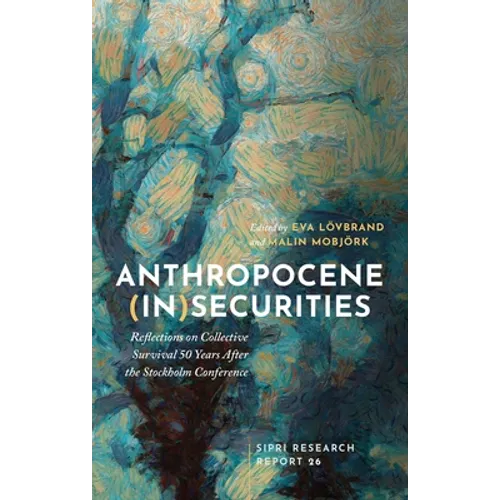
Product Description
by Eva Lövbrand (Editor), Malin Mobjörk (Editor)
In June 1972, the United Nations Conference on the Human Environment was held in Stockholm, Sweden. This event, also known as the Stockholm Conference, was the first of its kind and it reflected mounting concerns with the transboundary environmental problems caused by modern industrial society. Fifty years later, we find ourselves in a world marked by profound, accelerating, and possibly irreversible environmental change. Today, there is simply no place on earth untouched by human influence. The Anthropocene is a concept that has been advanced to capture this novel environmental condition. It refers to an unpredictable and fragile era in planetary history when humanity is dangerously disrupting the earth's biosphere and life-upholding systems.
This volume brings together an interdisciplinary team of scholars and policy experts to examine what security means in this new world of humanity's own making. It asks how global institutions can respond to the systemic production of environmental risks and insecurities, and what political innovations are needed to chart a more sustainable path for global development in the decades to come. The 50-year anniversary of the UN Conference on the Human Environment offers an important backdrop to the volume and an opportunity to imagine constructive ways ahead.Author Biography
Eva Lövbrand, Associate Professor of Environmental Change, the Department of Thematic Studies, Linköping University, Malin Mobjörk, Senior Research Officer, Department of Environmental Sciences, Formas, Sweden
Eva Lövbrand is Associate Professor in Environmental Change at the Department of Thematic Studies, Linköping University, and an Associated Senior Researcher to SIPRI. Her research examines the ideas, knowledge systems and expert practices that inform global environmental politics and governance. The knowledge politics of carbon has preoccupied much of her work. More recently she has also explored how the Anthropocene is imagined, known and acted upon as a political problem. She is co-editor of the volumes Environmental Politics and Deliberative Democracy: Exploring the Promise of New Modes of Governance (Edward Elgar, 2010), Research Handbook on Climate Governance (Edward Elgar, 2015) and Anthropocene Encounters: New Directions in Green Political Thinking (Cambridge University Press, 2019). Malin Mobjörk was (during the preparation of this volume) Senior Researcher and Director of SIPRI's Climate Change and Risk Programme. From March 2021, she began a new position at Formas, the Swedish funding agency for sustainable development. During the last decade, her work has focused on different aspects of the climate change and security debate. It has entailed work on a process-oriented approach to understand the linkages between climate change and violent conflict as well as research examining how different policy organizations are framing and responding to climate security challenges. More recently, she has published works in Earth System Governance, International Studies Review, the Journal of European Integration, Sustainability, and WIRE Climate Change. In addition, she has published regularly at SIPRI.