Product Description
by David M. O'Brien (Author)
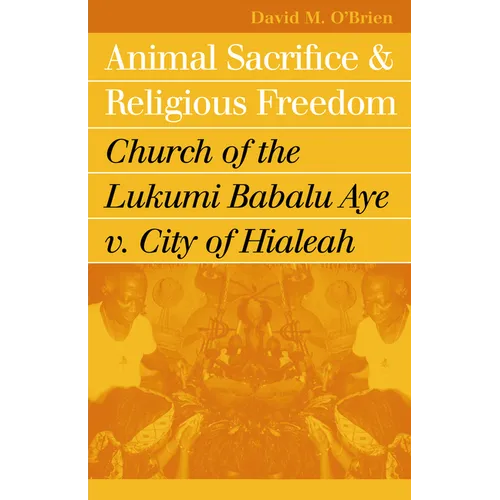
The Santeria religion of Cuba--the Way of the Saints--mixes West AfricanYoruba culture with Catholicism. Similar to Haitian voodoo, Santeria has long practiced animal sacrifice in certain rites. But when Cuban immigrants brought those rituals to Florida, local authorities were suddenly confronted with a controversial situation that pitted the regulation of public health and morality against religious freedom.
After Ernesto Pichardo established a Santeria church in Hialeah in the 1980s, the city of Hialeah responded by passing ordinances banning ritual animal sacrifice. Although on the surface those ordinances seemed general in intent, they were clearly aimed at Pichardo's church. When Pichardo subsequently sued the city, a federal court ruled in the latter's favor, in effect privileging the regulation of public health and morality over the church's free exercise of its religion. The U.S. Supreme Court heard Pichardo's appeal in 1993 and unanimously decided that the city had overstepped its bounds in targeting this particular religious group; however, the court was sharply divided regarding the basis of its decision. Three concurring opinions registered distinctly different views of the First Amendment, the limits of government regulation, and the religious freedom of minorities. In the end, the nine justices collectively concluded that freedom of religious belief was absolute while the freedom to practice the tenets of any faith were subject to non-discriminatory local regulations. David O'Brien, one of America's foremost scholars of the Court, now illuminates this controversy and its significance for law, government, and religion in America. His lively account takes us behind the scenes at every stage of the litigation to reveal a riveting case with more twists and turns than a classic whodunit. Ranging with equal ease from primitive magic to municipal politics and to the most arcane points of constitutional law, O'Brien weaves a compelling and instructive tale with a fascinating array of politicians, lawyers, jurists, civil libertarians, and animal rights advocates. Offering sharp insights into the key issues and personalities, he highlights cultural clashes large and small, while maintaining a balance for both the needs of government and the religious rights of individuals. The "Santeria case" reaffirmed that our laws must be generally applicable and neutral and may not discriminate against particular religions. Tracing the path to that conclusion, Animal Sacrifice and Religious Freedom provides a provocative and learned account of one of the most unusual and contentious religious freedom cases in American history.
Number of Pages: 208
Dimensions: 0.63 x 8.48 x 5.45 IN
Publication Date: April 10, 2004