


Product Description
by Charles S. Elton (Author)
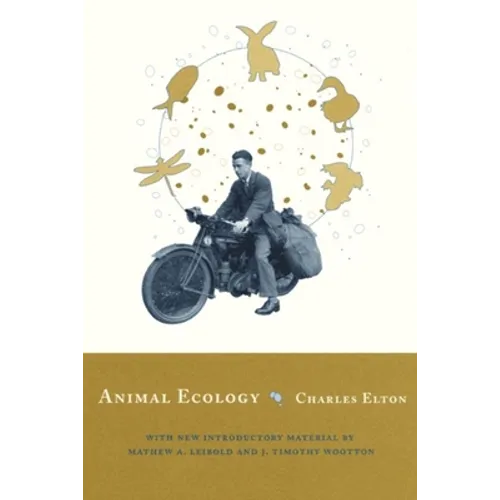
Charles Elton was one of the founders of ecology, and his Animal Ecology was one of the seminal works that defined the field. In this book Elton introduced and drew together many principles still central to ecology today, including succession, niche, food webs, and the links between communities and ecosystems, each of which he illustrated with well-chosen examples. Many of Elton's ideas have proven remarkably prescient-for instance, his emphasis on the role climatic changes play in population fluctuations anticipated recent research in this area stimulated by concerns about global warming.
For Chicago's reprint of this classic work, ecologists Mathew A. Leibold and J. Timothy Wootton have provided new introductions to each chapter, placing Elton's ideas in historical and scientific context. They trace modern developments in each of the key themes Elton introduced, and provide references to the most current literature. The result will be an important work for ecologists interested in the roots of their discipline, for educated readers looking for a good overview of the field, and for historians of science.Front Jacket
Charles Elton was one of the founders of ecology, and his Animal Ecology was one of the seminal works that defined the field. In this book Elton introduced and drew together many principles still central to ecology today, including succession, niche, food webs, and the links between communities and ecosystems, each of which he illustrated with well-chosen examples. Many of Elton's ideas have proven remarkably prescient--for instance, his emphasis on the role climatic changes play in population fluctuations anticipated recent research in this area stimulated by concerns about global warming.
For Chicago's reprint of this classic work, ecologists Mathew A. Leibold and J. Timothy Wootton have provided new introductions to each chapter, placing Elton's ideas in historical and scientific context. They trace modern developments in each of the key themes Elton introduced, and provide references to the most current literature. The result will be an important work for ecologists interested in the roots of their discipline, for educated readers looking for a good overview of the field, and for historians of science.Author Biography
Charles Elton established and led Oxford University's influential Bureau of Animal Population. He was the author of a number of books, among them The Ecology of Invasions by Animals and Plants, recently reprinted by the University of Chicago Press.
Mathew A. Leibold is an associate professor in the Department of Ecology and Evolution and chair of the Committee on Evolutionary Biology at the University of Chicago. J. Timothy Wootton is an associate professor in the Department of Ecology and Evolution and the Committee on Evolutionary Biology at the University of Chicago.


