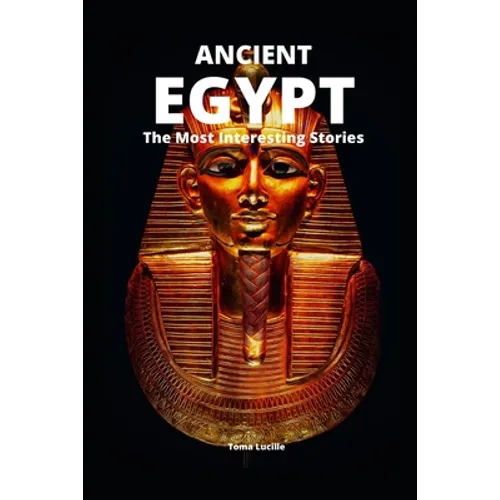
Product Description
by Toma Lucille (Author)
A great introduction to the ancient world. Learn many interesting facts, the position is ideal for those who have not been interested in ancient Egypt so far, but also those who have already been interested in it will find something interesting. The history of Egypt interested the ancients themselves and did not cease to fascinate researchers of later periods. The nineteenth century brought a breakthrough in the form of the reading of Egyptian writing (Jean-Fran ois Champollion, Ippolito Rosellini), which made it possible to decipher the inscriptions and recreate the political history. The widespread interest of the 19th-century European societies, informed on an ongoing basis about the progress of works thanks to the dynamically developing press, led to a series of archaeological research expeditions and, as a result, laying the foundations for modern Egyptology. The origins of Egyptian civilization date back to the unification of the delta region (Lower Egypt) and the Nile Valley (Upper Egypt) in the predynastic period (c. 3500 BC). In historical times, successive variants of statehood followed one another in the form of uniform kingdoms (Old, Middle and New State), separated by periods of disintegration (First, Second and Third Transitional Period). The declining period (1st millennium BCE) is the dominance of Assyria and Persia, and from the conquests of Alexander the Great, the Hellenistic period in the history of Egypt. The last form of ancient Egyptian statehood was the creation of a Roman province from the country on the Nile during the reign of Octavian Augustus (until the Arab conquest in the 7th century CE). The specific location was the main reason for the greatness and durability of the gains of Egyptian civilization. Communication through Sinai and Syropalestine with great civilization centers, such as Mesopotamia, Anatolia, and later ancient Greece, favored the exchange of ideas. The simultaneous ease of defense against threats from this neighborhood thanks to natural conditions (the Arabian Desert, the Red Sea, the deserts of the Arabian Peninsula in the east; the Mediterranean Sea in the north; the Sahara in the west) led to the persistence and homogeneity of Egyptian culture. The regular flooding of the Nile and, consequently, the high fertility of the soil were beneficial for the development of agriculture. The maintenance of a complex irrigation system created the need for administrative supervision, which in turn led to the creation of a strong central authority, which was later religiously ideologized, and the creation of a writing (hieroglyphs). The proximity of copper, gold and precious stone mines (Sinai, Nubia) contributed to the development of crafts and trade with neighbors, and the general availability of a durable building material in the form of stone favored the development of construction. Religion was a distinctive feature that distinguished Egypt from other civilizations in the ancient Near East. Its leitmotif - belief in life after death and the cult of the ruler, led to the construction of powerful tombs, which are still one of the most important sources of learning about the history, culture and mind of the ancient Egyptians.