Skip to content
Welcome To Our Store.
100,000+ Products for Home, Medical, Office & Classroom Needs
Search
Skip to product information
1 of 2

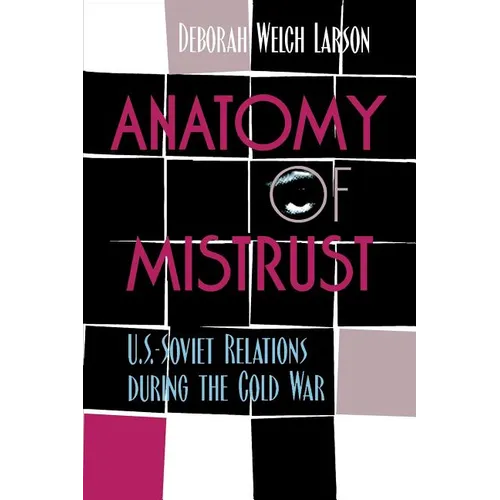
Anatomy of Mistrust: U.S.-Soviet Relations during the Cold War - Paperback

$71.91 USD
$71.91 USD
Sale Sold out
Shipping calculated at checkout.
In stock (100 units), ready to be shipped

Available Offers

Fast delivery available on most orders

Multiple secure payment options accepted

Secure checkout with
  • American Express
  • Apple Pay
  • Diners Club
  • Discover
  • Google Pay
  • Mastercard
  • PayPal
  • Shop Pay
  • Visa

Flight Range: Up to 1,000 meters (3,280 feet)

Maximum Speed: 45 kilometers per hour (28 miles per hour)

For all orders exceeding a value of 100USD shipping is offered for free.

Returns will be accepted for up to 10 days of Customer’s receipt or tracking number on unworn items. You, as a Customer, are obliged to inform us via email before you return the item.

Otherwise, standard shipping charges apply. Check out our delivery Terms & Conditions for more details.

View Product Details
Shopping cart
Product Product subtotal Quantity Price Product subtotal
Anatomy of Mistrust: U.S.-Soviet Relations during the Cold War - Paperback
$71.91/ea
$0.00
$71.91/ea $0.00

Product Description

by Deborah Welch Larson (Author)

The United States and the Soviet Union missed numerous diplomatic opportunities to resolve differences and control the arms race because neither state trusted the other, according to Deborah Welch Larson. In Anatomy of Mistrust, she shows that the goals of Soviet and U.S. leaders were frequently complementary, and an agreement should have been attainable. Lost opportunities contributed to bankruptcy for the Soviet Union, serious damage to the economy of the United States, decreased public support for internationalist policies, and a proliferation of nuclear weapons.

Synthesizing different understandings of trust and mistrust from the theoretical traditions of economics, psychology, and game theory, Larson analyzes five cases that might have been turning points in U.S.-Soviet relations: the two-year period following Stalin's death in 1953; Khrushchev's peace offensive from the launching of Sputnik until the U-2 incident; the Kennedy administration; the Nixon-Brezhnev detente; and the Gorbachev period. Larson concludes that leaders in the United States often refused to accept Soviet offers to negotiate because they feared a trap. Mutual trust is necessary, she concludes, although it may not be sufficient, for states to cooperate in managing their security.

Author Biography

Deborah Welch Larson is professor of political science at the University of California, Los Angeles.

Number of Pages: 352
Dimensions: 0.94 x 9.27 x 6.13 IN
Publication Date: September 26, 2000
you might like