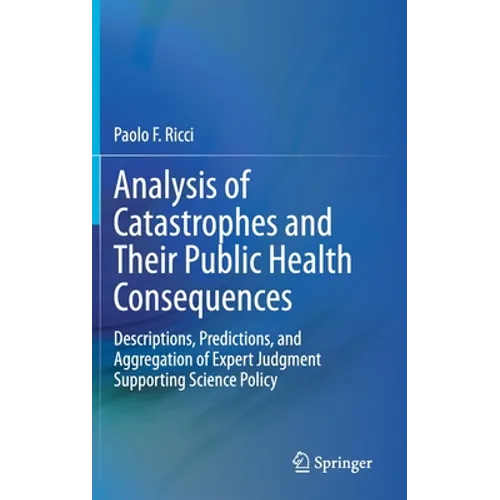
Product Description
by Paolo F. Ricci (Author)
Public health policy prospectively and retrospectively addresses the consequences of events ranging from the commonplace to the catastrophic. Informing policymakers and stakeholders by enhancing their understanding of complex causation to justify remedial or precautionary actions is a critical science-policy task. In this book, the key aspects of catastrophes (regardless of their nature) and routine events are identified through a common framework for their analyses, and the analyses of the consequences associated with the potential occurrence of these events also are discussed. The book is not about disaster planning; instead, it is focused on analysis and causation in the context of informing - rather than formulating - public health policy.
The author aggregates and fuses scientific information and knowledge in public health policy-science using alternative but complementary methods. The book first focuses on the analysis of catastrophes and commonplace events; the focus then shifts to causal models of multifactorial diseases, particularly at low doses or dose-rates, associated with these events. Topics explored among the chapters include:
- Policy and Legal Aspects of Precautionary Choices
- Catastrophes, Disasters, and Calamities: Concepts for Their Assessment
- Uncertainty: Probabilistic and Statistical Aspects
- Aggregating Judgments to Inform Precautionary Decision-making
The aim of the book is to show that the analyses of events are fundamentally similar, regardless of whether the concern is a global catastrophe or commonplace.
Analysis of Catastrophes and Their Public Health Consequences is a text that should engage students, instructors, and researchers in public health, science policy, and preparedness research, as well as serve as a useful resource for policy analysts, practitioners, and risk managers.
Back Jacket
Public health policy prospectively and retrospectively addresses the consequences of events ranging from the commonplace to the catastrophic. Informing policymakers and stakeholders by enhancing their understanding of complex causation to justify remedial or precautionary actions is a critical science-policy task. In this book, the key aspects of catastrophes (regardless of their nature) and routine events are identified through a common framework for their analyses, and the analyses of the consequences associated with the potential occurrence of these events also are discussed. The book is not about disaster planning; instead, it is focused on analysis and causation in the context of informing - rather than formulating - public health policy.
The author aggregates and fuses scientific information and knowledge in public health policy-science using alternative but complementary methods. The book first focuses on the analysis of catastrophes and commonplace events; the focus then shifts to causal models of multifactorial diseases, particularly at low doses or dose-rates, associated with these events. Topics explored among the chapters include:
- Policy and Legal Aspects of Precautionary Choices
- Catastrophes, Disasters, and Calamities: Concepts for Their Assessment
- Uncertainty: Probabilistic and Statistical Aspects
- Aggregating Judgments to Inform Precautionary Decision-making
The aim of the book is to show that the analyses of events are fundamentally similar, regardless of whether the concern is a global catastrophe or commonplace.
Analysis of Catastrophes and Their Public Health Consequences is a text that should engage students, instructors, and researchers in public health, science policy, and preparedness research, as well as serve as a useful resource for policy analysts, practitioners, and risk managers.
Author Biography
Paolo F. Ricci, PhD, LLM, is a professor at the EU's Erasmus Mundus Programs in Italy, Spain, and Portugal. Previously he was a professor at the School of Public Health at the University of Massachusetts at Amherst; professor at Holy Names University in Oakland, California, USA; visiting professor at Xiamen University in China; and, professor at University of Bologna in Italy. For more than 30 years, Dr. Ricci -- a senior Fulbright scholar (specialist, 2010-2015) and appointed peer reviewer for Fulbright Specialists selection (2013-2014) -- has led qualitative and quantitative analyses in public health and epidemiology and conducted experimental work in, among other countries, the United States, Canada, Italy, Australia, France, Vietnam, China, the Ivory Coast, and the European Union. He was the head of the Environmental Technologies Clearinghouse of the IEA/OECD (with full diplomatic status) and has served as a peer reviewer of U.S. Department of Energy (DOE) activities regarding human health risks from past nuclear weapons tests at the Nevada Test Site. Until 2014, Dr. Ricci was an associate editor of the journal Environment International for more than 15 years.