Product Description
by Francis X. Giraldo (Author)
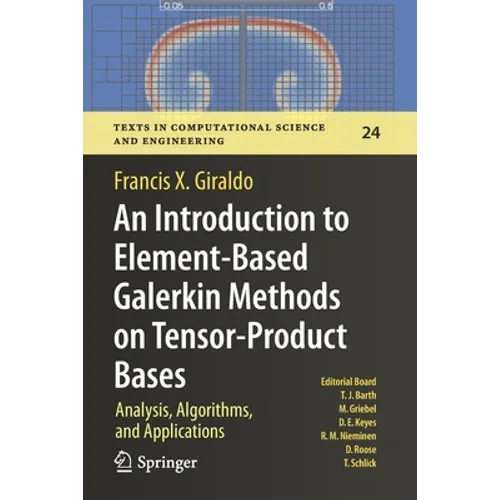
This book introduces the reader to solving partial differential equations (PDEs) numerically using element-based Galerkin methods. Although it draws on a solid theoretical foundation (e.g. the theory of interpolation, numerical integration, and function spaces), the book's main focus is on how to build the method, what the resulting matrices look like, and how to write algorithms for coding Galerkin methods. In addition, the spotlight is on tensor-product bases, which means that only line elements (in one dimension), quadrilateral elements (in two dimensions), and cubes (in three dimensions) are considered. The types of Galerkin methods covered are: continuous Galerkin methods (i.e., finite/spectral elements), discontinuous Galerkin methods, and hybridized discontinuous Galerkin methods using both nodal and modal basis functions. In addition, examples are included (which can also serve as student projects) for solving hyperbolic and elliptic partial differential equations, includingboth scalar PDEs and systems of equations.
Back Jacket
This book introduces the reader to solving partial differential equations (PDEs) numerically using element-based Galerkin methods. Although it draws on a solid theoretical foundation (e.g. the theory of interpolation, numerical integration, and function spaces), the book's main focus is on how to build the method, what the resulting matrices look like, and how to write algorithms for coding Galerkin methods. In addition, the spotlight is on tensor-product bases, which means that only line elements (in one dimension), quadrilateral elements (in two dimensions), and cubes (in three dimensions) are considered. The types of Galerkin methods covered are: continuous Galerkin methods (i.e., finite/spectral elements), discontinuous Galerkin methods, and hybridized discontinuous Galerkin methods using both nodal and modal basis functions. In addition, examples are included (which can also serve as student projects) for solving hyperbolic and elliptic partial differential equations, including both scalar PDEs and systems of equations.
Author Biography
Francis (Frank) Giraldo is a Distinguished Professor of Applied Mathematics at the Naval Postgraduate School and a founding member of the Scientific Computing group. He and his team built the NUMA model using the element-based Galerkin (EBG) methods described in this text; NUMA is a Navier-Stokes solver used for atmospheric, ocean, and fluid dynamics simulations. Frank Giraldo (and colleagues) hosted the 2012 Gene Golub SIAM Summer School on Simulation and Supercomputing in the Geosciences where EBG methods was one of the topics of the summer course. In addition, Frank has served on the National Earth Systems Prediction Capability working groups for over 10 years, and has served on the Department of Energy's INCITE panels for over 5 years (including chairing the committee a number of times).