Skip to content
Welcome To Our Store.
100,000+ Products for Home, Medical, Office & Classroom Needs
Search
Skip to product information
1 of 2

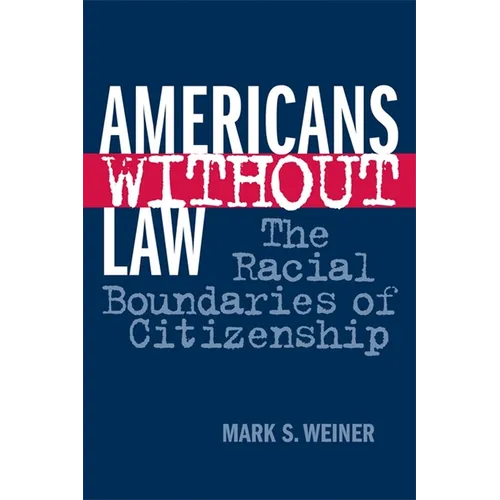
Americans Without Law: The Racial Boundaries of Citizenship - Paperback

$58.14 USD
$58.14 USD
Sale Sold out
Shipping calculated at checkout.
In stock (100 units), ready to be shipped

Available Offers

Fast delivery available on most orders

Multiple secure payment options accepted

Secure checkout with
  • American Express
  • Apple Pay
  • Diners Club
  • Discover
  • Google Pay
  • Mastercard
  • PayPal
  • Shop Pay
  • Visa

Flight Range: Up to 1,000 meters (3,280 feet)

Maximum Speed: 45 kilometers per hour (28 miles per hour)

For all orders exceeding a value of 100USD shipping is offered for free.

Returns will be accepted for up to 10 days of Customer’s receipt or tracking number on unworn items. You, as a Customer, are obliged to inform us via email before you return the item.

Otherwise, standard shipping charges apply. Check out our delivery Terms & Conditions for more details.

View Product Details
Shopping cart
Product Product subtotal Quantity Price Product subtotal
Americans Without Law: The Racial Boundaries of Citizenship - Paperback
$58.14/ea
$0.00
$58.14/ea $0.00

Product Description

by Mark S. Weiner (Author)

Americans Without Law shows how the racial boundaries of civic life are based on widespread perceptions about the relative capacity of minority groups for legal behavior, which Mark S. Weiner calls "juridical racialism." The book follows the history of this civic discourse by examining the legal status of four minority groups in four successive historical periods: American Indians in the 1880s, Filipinos after the Spanish-American War, Japanese immigrants in the 1920s, and African Americans in the 1940s and 1950s.
Weiner reveals the significance of juridical racialism for each group and, in turn, Americans as a whole by examining the work of anthropological social scientists who developed distinctive ways of understanding racial and legal identity, and through decisions of the U.S. Supreme Court that put these ethno-legal views into practice. Combining history, anthropology, and legal analysis, the book argues that the story of juridical racialism shows how race and citizenship served as a nexus for the professionalization of the social sciences, the growth of national state power, economic modernization, and modern practices of the self.


Number of Pages: 205
Dimensions: 0.7 x 8.7 x 5.8 IN
Publication Date: December 01, 2008
you might like
