


Product Description
by John F. Kreis (Author)
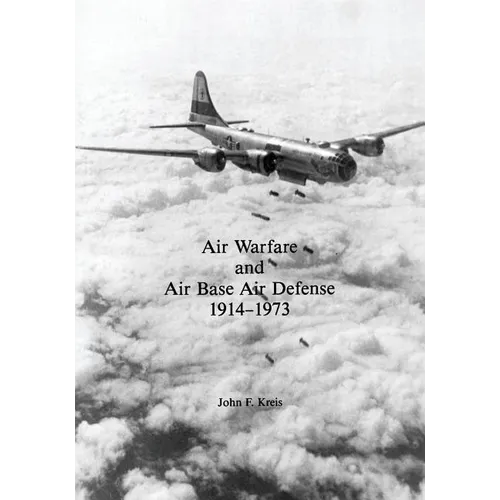
While the projection of air power in contemporary warfare is among the most complex endeavors facing a military commander, few of the activities required to support and sustain air forces in battle have been explored in depth in historical literature. Even less studied has been the defense of air bases. Since the introduction of airplanes to warfare, it was obvious that bases must be kept functioning at peak efficiency to seize and maintain air superiority over an enemy as well as to carry out close air support and interdiction operations. A number of factors have been critical in actions involving air bases: advancing technology in aircraft and in defensive weapons, command and control systems, detection capabilities, evolving air power doctrine that predisposes air forces to specific courses of action, human endurance and morale, camouflage or concealment, dispersion, the ability to foresee and counter the strategy of a potential enemy, and in many cases pure chance that favors one side over the other. In response to a request by the Air Force Director of Plans, the Office of Air Force History undertook to condense into one volume the experiences of various nations' air forces in defending air bases against attacks from the air. Maj. John Kreis, an experienced air security officer who spent much of his career providing protection for U. S. Air Force bases, accomplished this task by adopting a case study approach that highlights the interplay of the factors affecting air base defense over half a century. In these pages he has presented examples of the earliest attempts to defend airfields and troops in World War I from aerial assault. He chronicles the development of radar and command organizations that influenced so heavily the Royal Air Force's performance in the Battle of Britain, the ability to marshal defenses and repair crews on the island of Malta, and evolving command arrangements in North Africa that made for success against a capable enemy whose own command arrangements were deficient. Cases were also chosen to investigate failures from which sound lessons could be drawn. Limited conflict in the cold war world has imposed its own logic on base defense and attacks on installations, and the examples of base destruction in the Middle East wars between 1948 and 1973 are also instructive. This volume has wide application in staff planning for developing base defensive emplacements, providing repair and support services, and training base personnel to react in a host of contingencies. For the Air Force gene ally, it offers new insights into matters not usually treated in doctrinal literature. The cases elaborated upon here will also have an appeal to a wider public audience interested in military aviation in all of its aspects.