Product Description
by Aurelia Tamo-Larrieux (Author), Clement Guitton (Author), Simon Mayer (Author)
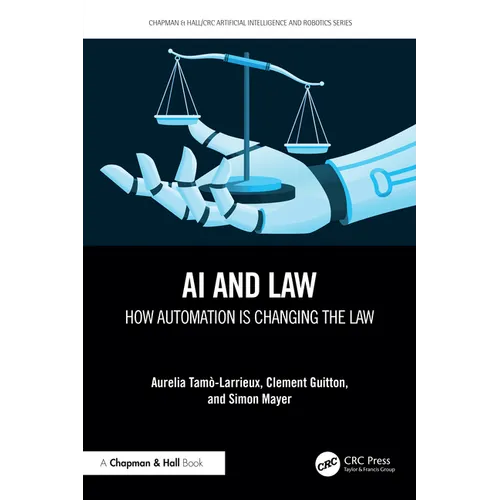
This book provides insights into how AI is changing legal practice, government processes, and individuals' access to those processes, encouraging each of us to consider how technological advances are changing the legal system. Particularly, and distinct from current debates on how to regulate AI, this books focuses on how the progressive merger between computational methods and legal rules changes the very structure and application of the law itself.
We investigate how automation is changing the legal analysis, legal rulemaking, legal rule extraction, and application of legal rules and how this impacts individuals, policymakers, civil servants, and society at large. We show through many examples that a debate on how automation is changing the law is needed, which must revolve around the democratic legitimacy of the automation of legal processes, and be informed by the technical feasibility and tradeoffs of specific endeavors.
Author Biography
Aurelia Tamo-Larrieux is an associate professor at the University of Lausanne (UNIL), Faculty of Law, heading the team of Digital and Computational Law and leading the Legal Design & Code Lab. Previously, she was an assistant professor at Maastricht University and a member of the Law & Tech Lab. She has a background in law and economics and specializes in research at the intersection of law and digital technologies with numerous publications and projects in the field of privacy, data protection, design approaches, transparency of automated decision-making, automatically processable regulation, and trust in automation.
Clement Guitton is currently a postdoctoral researcher at the University of St. Gallen, focusing on topics around law and technology, or more generally on understanding and developing policy solutions around technology. He previously worked on cyber security, bringing together the fields of politics and technology. He has published dozens of peer-reviewed journal articles, and AI and Law is his fourth book. He has degrees in telecommunication engineering, international affairs, and finance. In the past, he worked in counter-espionage, consulting at the International Telecommunication Union and as a political analyst for a large reinsurance company.
Simon Mayer is a professor at the Institute of Computer Science at the University of St. Gallen, Switzerland, where he heads the Chair for Interaction- and Communication-based Systems. Previously, he worked at Siemens Corporate Technology in Berkeley, USA, most recently as senior key expert for Smart and Interacting Systems, and afterward headed the Cognitive Products research group at the Austrian COMET research center Pro2Future at Graz University of Technology. Simon holds degrees in Computer Science, Economics and Business Administration, and Secondary and Higher Education; he has co-authored more than 200 journal, magazine, conference, and workshop publications on the topics of ubiquitous computing, the Web of Things, autonomous systems, and interoperability, and is serving on the steering committee of the International Conference on the Internet of Things as well as the editorial board of the IEEE Pervasive Computing magazine.