Product Description
by Rebecca K. Marchiel (Author)
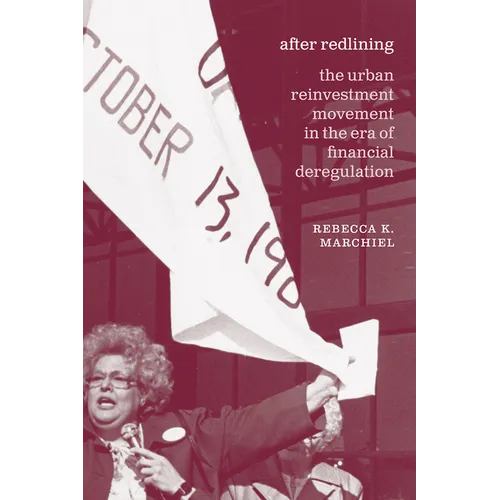
Focusing on Chicago's West Side, After Redlining illuminates how urban activists were able to change banks' behavior to support investment in communities that they had once abandoned.
American banks, to their eternal discredit, long played a key role in disenfranchising nonwhite urbanites and, through redlining, blighting the very city neighborhoods that needed the most investment. Banks long showed little compunction in aiding and abetting blockbusting, discrimination, and outright theft from nonwhites. They denied funds to entire neighborhoods or actively exploited them, to the benefit of suburban whites--an economic white flight to sharpen the pain caused by the demographic one. And yet, the dynamic between banks and urban communities was not static, and positive urban development, supported by banks, became possible. In After Redlining, Rebecca K. Marchiel illuminates how, exactly, urban activists were able to change some banks' behavior to support investment in communities that they had once abandoned. The leading activists arose in an area hit hard by banks' discriminatory actions and politics: Chicago's West Side. A multiracial coalition of low- and moderate-income city residents, this Saul Alinsky-inspired group championed urban reinvestment. And amazingly, it worked: their efforts inspired national action, culminating in the federal Home Mortgage Disclosure Act and the Community Reinvestment Act.
While the battle for urban equity goes on, After Redlining provides a blueprint of hope.
Author Biography
Rebecca K. Marchiel is assistant professor of history at the University of Mississippi.
Number of Pages: 296
Dimensions: 0.72 x 9 x 6 IN
Illustrated: Yes
Publication Date: September 13, 2021