Product Description
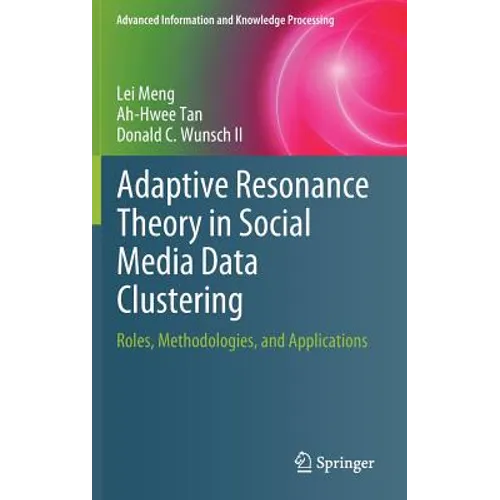
by Lei Meng (Author), Ah-Hwee Tan (Author), Donald C. Wunsch II (Author)
Social media data contains our communication and online sharing, mirroring our daily life. This book looks at how we can use and what we can discover from such big data:
- Basic knowledge (data & challenges) on social media analytics
- Clustering as a fundamental technique for unsupervised knowledge discovery and data mining
- A class of neural inspired algorithms, based on adaptive resonance theory (ART), tackling challenges in big social media data clustering
-
Step-by-step practices of developing unsupervised machine learning algorithms for real-world applications in social media domain
Adaptive Resonance Theory in Social Media Data Clustering stands on the fundamental breakthrough in cognitive and neural theory, i.e. adaptive resonance theory, which simulates how a brain processes information to perform memory, learning, recognition, and prediction.
It presents initiatives on the mathematical demonstration of ART's learning mechanisms in clustering, and illustrates how to extend the base ART model to handle the complexity and characteristics of social media data and perform associative analytical tasks.
Both cutting-edge research and real-world practices on machine learning and social media analytics are included in the book and if you wish to learn the answers to the following questions, this book is for you:
- How to process big streams of multimedia data?
- How to analyze social networks with heterogeneous data?
- How to understand a user's interests by learning from online posts and behaviors?
- How to create a personalized search engine by automatically indexing and searching multimodal information resources?
.
Back Jacket
Social media data contains our communication and online sharing, mirroring our daily life. This book looks at how we can use and what we can discover from such big data:
- Basic knowledge (data & challenges) on social media analytics
- Clustering as a fundamental technique for unsupervised knowledge discovery and data mining
- A class of neural inspired algorithms, based on adaptive resonance theory (ART), tackling challenges in big social media data clustering
-
Step-by-step practices of developing unsupervised machine learning algorithms for real-world applications in social media domain
Adaptive Resonance Theory in Social Media Data Clustering stands on the fundamental breakthrough in cognitive and neural theory, i.e. adaptive resonance theory, which simulates how a brain processes information to perform memory, learning, recognition, and prediction.
It presents initiatives on the mathematical demonstration of ART's learning mechanisms in clustering, and illustrates how to extend the base ART model to handle the complexity and characteristics of social media data and perform associative analytical tasks.
Both cutting-edge research and real-world practices on machine learning and social media analytics are included in the book and if you wish to learn the answers to the following questions, this book is for you:
- How to process big streams of multimedia data?
- How to analyze social networks with heterogeneous data?
- How to understand a user's interests by learning from online posts and behaviors?
- How to create a personalized search engine by automatically indexing and searching multimodal information resources?