


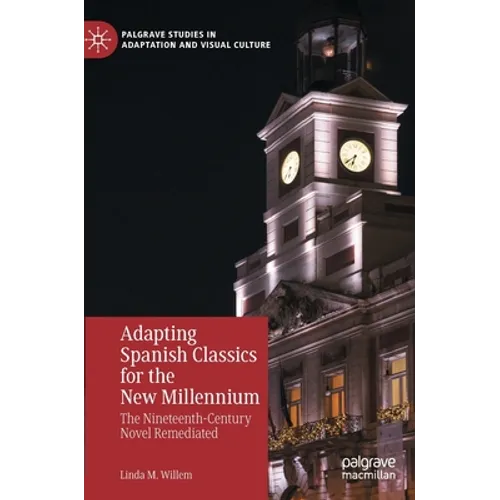
Product Description
by Linda M. Willem (Author)
The twenty-first-century's turn away from fidelity-based adaptations toward more innovative approaches has allowed adapters from Spain, Argentina, and the United States to draw upon Spain's rich body of nineteenth-century classics to address contemporary concerns about gender, sexuality, race, class, disability, celebrity, immigration, identity, social justice, and domestic violence. This book provides a snapshot of visual adaptations in the first two decades of the new millennium, examining how novelistic material from the past has been remediated for today's viewers through film, television, theater, opera, and the graphic novel. Its theoretical approach refines the binary view of adapters as either honoring or opposing their source texts by positing three types of adaptation strategies: salvaging (which preserves old stories by giving them renewed life for modern audiences), utilizing (which draws upon a pre-existing text for an alternative purpose, building upon the story and creating a shift in emphasis without devaluing the source material), and appropriation (which involves a critique of the source text, often with an attempt to dismantle its authority). Special attention is given to how adapters address audiences that are familiar with the source novels, and those that are not. This examination of the vibrant afterlife of classic literature will be of interest to scholars and educators in the fields of adaptation, media, Spanish literature, cultural studies, performance, and the graphic arts.
Back Jacket
The focus on twenty-first-century adaptations--many of them little known--of nineteenth-century Spanish novels produces a highly original study, particularly since the adaptations are discussed on their own merits as creative responses to contemporary concerns such as disability, indebtedness, and domestic violence. The stress on free adaptations--in cinema, television, theatre, opera, and graphic narrative--is refreshing. Particularly welcome is the attention not just to the visual reimagining of literary sources but also to the use of musical effects. Readers will take away from this book an appreciation of the inventiveness of contemporary Spanish cultural production.
--Jo Labanyi, New York University (USA)
Those who are suspicious of non-traditional adaptations of classic literary works will change their minds after reading Linda Willem's studies of re-mediated versions of nineteenth-century Spanish novels. The adaptations vividly illustrate each work's relevance to contemporary concerns, and Willem's analyses bring fresh understanding both to the original works and to the creative re-envisionings of them. Each chapter allows nonspecialists to discover the richness of works by Alas, Galdós, Pardo Bazán, Valera, and Blasco Ibáñez, while making specialists eager to re-read the original works and to teach them with their adaptations. Everyone who is interested in adaptation will enjoy this volume.--Joyce Tolliver, University of Illinois at Urbana-Champaign (USA)
The twenty-first-century's turn away from fidelity-based adaptations toward more innovative approaches has allowed adapters from Spain, Argentina, and the United States to draw upon Spain's rich body of nineteenth-century classics to address contemporary concerns about gender, sexuality, race, class, disability, celebrity, immigration, identity, social justice, and domestic violence. This book provides a snapshot of visual adaptations in the first two decades of the new millennium, examining how novelistic material from the past has been remediated for today's viewers through film, television, theater, opera, and the graphic novel. Its theoretical approach refines the binary view of adapters as either honoring or opposing their source texts by positing three types of adaptation strategies: salvaging (which preserves old stories by giving them renewed life for modern audiences), utilizing (which draws upon a pre-existing text for an alternative purpose, building upon the story and creating a shift in emphasis without devaluing the source material), and appropriation (which involves a critique of the source text, often with an attempt to dismantle its authority). Special attention is given to how adapters address audiences that are familiar with the source novels, and those that are not. This examination of the vibrant afterlife of classic literature will be of interest to scholars and educators in the fields of adaptation, media, Spanish literature, cultural studies, performance, and the graphic arts. Linda M. Willem is the Betty Blades Lofton Professor of Spanish at Butler University (USA).
Author Biography
Linda M. Willem is the Betty Blades Lofton Professor of Spanish at Butler University (USA).



