


Product Description
by Roy Chapman Andrews (Author)
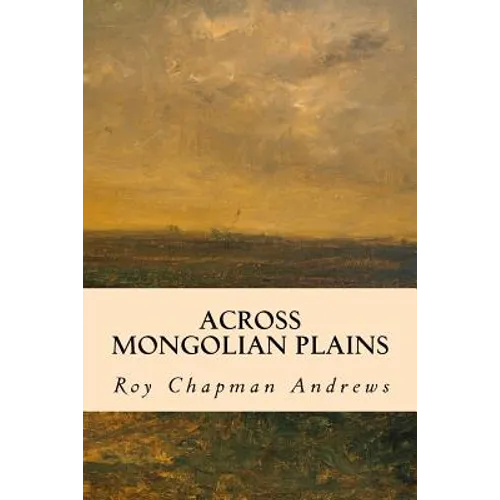
Across Mongolian Plains-A Naturalists Account of China's "Great Northwest" is an Asian travel diary by Roy Chapman Andrews. This Asian travelogue is the narrative of our work and travels. I have written it entirely from the sportsman's standpoint and have purposely avoided scientific details which would prove uninteresting or wearisome to the general public. Roy Chapman Andrews (January 26, 1884 - March 11, 1960) was an American explorer, adventurer and naturalist who became the director of the American Museum of Natural History. 1] He is primarily known for leading a series of expeditions through the politically disturbed China of the early 20th century into the Gobi Desert and Mongolia. The expeditions made important discoveries and brought the first-known fossil dinosaur eggs to the museum. His popular writings about his adventures made him famous. From 1909 to 1910, Andrews sailed on the USS Albatross to the East Indies, collecting snakes and lizards and observing marine mammals. In 1913, he sailed aboard the schooner Adventuress with owner John Borden to the Arctic. They were hoping to obtain a bowhead whale specimen for the American Museum of Natural History. On this expedition, he filmed some of the best footage of seals ever seen, though did not succeed in acquiring a whale specimen. He married Yvette Borup in 1914. From 1916 to 1917, Andrews and his wife led the Asiatic Zoological Expedition of the museum through much of western and southern Yunnan, as well as other provinces of China. The book Camps and Trails in China records their experiences. In 1920, Andrews began planning for expeditions to Mongolia and drove a fleet of Dodge cars westward from Peking. In 1922, the party discovered a fossil of Indricotherium (then named "Baluchitherium"), a gigantic hornless rhinoceros, which was sent back to the museum, arriving on December 19. The fossil species Andrewsarchus was named after him. Andrews, along with Henry Fairfield Osborn, was a proponent of the Out of Asia theory of humanity's origins and led several expeditions to Asia from 1922 to 1928 known as the "Central Asiatic Expeditions" to search for the earliest human remains in Asia. The expeditions did not find human remains. However, Andrews and his team made many other finds, including dinosaur bones and fossil mammals and most notably the first nests full of dinosaur eggs ever discovered (see below). Andrews's main account of these expeditions can be found in his book The New Conquest of Central Asia. Andrews is allegedly the real person that the movie character of Indiana Jones was patterned after. Andrews was an accomplished stage master. He created an image and lived it out impeccably-there was no chink in his armor. Roy Chapman Andrews: famous explorer, dinosaur hunter, exemplar of Anglo-Saxon virtues, crack shot, fighter of Mongolian brigands, the man who created the metaphor of 'Outer Mongolia' as denoting any exceedingly remote place.