


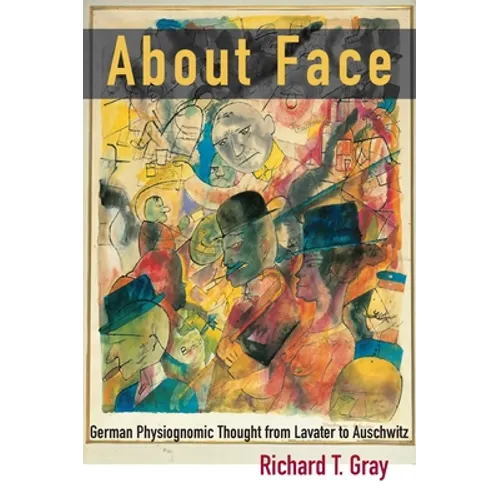
Product Description
by Richard T. Gray (Author)
Once associated with astrology and occultist prophecy, the art of interpreting personal character based on facial and other physical features dates back to antiquity. About Face tells the intriguing story of how physiognomics became particularly popular during the Enlightenment, no longer as a mere parlor game but as an empirically grounded discipline. The story expands to illuminate an entire tradition within German culture, stretching from Goethe to the rise of Nazism.
In About Face, Richard T. Gray explores the dialectical reversal--from the occult to the scientific realm--that entered physiognomic thought in the late eighteenth century, beginning with the positivistic writings of the Swiss pastor Johann Caspar Lavater. Originally claimed to promote understanding and love, physiognomics devolved into a system aimed at valorizing a specific set of physical, moral, and emotional traits and stamping everything else as "deviant." This development not only reinforced racial, national, and characterological prejudices, but lent such beliefs a presumably scientific grounding.
In the period following World War I, physiognomics experienced yet another, unprecedented boom in popularity. Gray explains how physiognomics had by then become a highly respected "super-discipline" that embraced many prominent strands of German thought: the Romantic philosophy of nature, the "life philosophy" propagated by Dilthey and Nietzsche, the cultural pessimism of Schopenhauer, Husserl's method of intuitive observation, Freudian psychoanalysis, and early-twentieth-century eugenics and racial biology. A rich exploration of German culture, About Face offers fresh insight into the intellectual climate that allowed the dangerous thinking of National Socialism to take hold.
Author Biography
Richard T. Gray is the Byron W. and Alice L. Lockwood Professor in the Humanities at the University of Washington. He teaches in the Department of Germanics.



