Product Description
by Nathanial Gronewold (Author)
It's been 50 years since the United States attempted a conservation revolution with the passing of the Endangered Species Act in 1973. Now, fifty years later, the Fish and Wildlife Service finds itself at a crossroads: some recovery efforts are succeeding, but too many are either failing or stuck in neutral, even after decades of work.
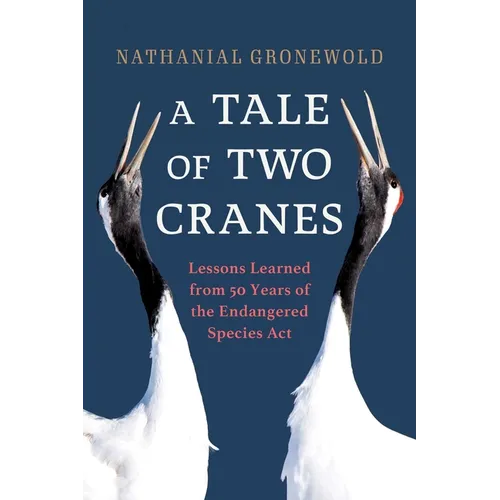
Take, for example, the story of two cranes, the whoopingcrane of southeastern Texas and the red-crowned crane of northern Japan. Both were pushed to the brink of extinction by the early 1900s, with surviving populations numbering as few as 20 to 40 individuals, and are now the subjects of concerted recovery efforts led by advanced national governments. The U.S. Fish and Wildlife Service has focused mainly on habitat protection, while at Japan's Ministry of the Environment, conservation authorities have leaned most heavily on direct population survival via a long-standing winter feeding program. These two case studies provide a template for comparing different approaches towards endangered species: habitat management vs. population management. Thus far the Japanese approach has proved more successful, but the story isn't over yet. What can these lessons teach us about managing other endangered species? Can species rehabilitation be standardized, or must each effort be designed and implemented on a case-by-case basis?
A Tale of Two Cranes will serve as a launching pad for better understanding the progress and pitfalls inherent in endangered species management, through 50 years of lessons learned since the landmark Endangered Species Act was enacted by the United States Congress in December 1973. Also considering its success stories like the Attwater's prairie chicken, the ESA has had an enormous impact on conservation theory and practice throughout the world, from Tasmanian devils in Australia to the vaquita porpoises of Mexico. But, worsening government budget constraints, public inattention, and a continuous string of setbacks experienced within numerous rehabilitation initiatives will all eventually conspire to challenge the conventional thinking on endangered species management like never before.
Author Nathanial Gronewold explains how we got here, where things stand today, and what lessons conservationists must take to heart as the world continues to struggle to put a halt to an ongoing global extinction crisis.
Author Biography
Nathanial Gronewold is an award-winning veteran journalist who's reported from ten countries on five continents. He's earned two National Press Club awards and three honors from the United Nations Correspondents Association, including two UNCA Gold prizes. Gronewold is Editor-in-Chief of Public Parks (publicparks.org), launching in mid-2023 to cover the science and policy supporting the world's public lands. He's a member of the faculty at the University of Hawai'i at Manoa, where he teaches journalism and advises student media operations. He holds a master's degree in ecosystem science and management and will have earned his PhD in environmental science by the time this book is published. Gronewold is the author of Anthill Economics: Animal Ecosystems and the Human Economy.