


Product Description
by David Vernon (Author), Claes Von Hofsten (Author), Luciano Fadiga (Author)
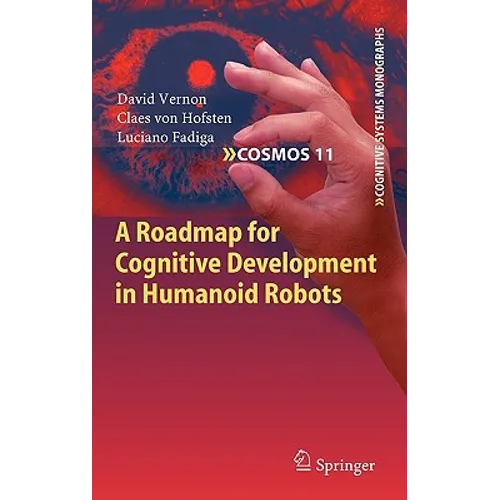
This book addresses the central role played by development in cognition. The focus is on applying our knowledge of development in natural cognitive systems, specifically human infants, to the problem of creating artificial cognitive systems in the guise of humanoid robots. The approach is founded on the three-fold premise that (a) cognition is the process by which an autonomous self-governing agent acts effectively in the world in which it is embedded, (b) the dual purpose of cognition is to increase the agent's repertoire of effective actions and its power to anticipate the need for future actions and their outcomes, and (c) development plays an essential role in the realization of these cognitive capabilities. Our goal in this book is to identify the key design principles for cognitive development. We do this by bringing together insights from four areas: enactive cognitive science, developmental psychology, neurophysiology, and computational modelling. This results in roadmap comprising a set of forty-three guidelines for the design of a cognitive architecture and its deployment in a humanoid robot. The book includes a case study based on the iCub, an open-systems humanoid robot which has been designed specifically as a common platform for research on embodied cognitive systems .
Back Jacket
This book addresses the central role played by development in cognition. The focus is on applying our knowledge of development in natural cognitive systems, specifically human infants, to the problem of creating artificial cognitive systems in the guise of humanoid robots. The approach is founded on the three-fold premise that (a) cognition is the process by which an autonomous self-governing agent acts effectively in the world in which it is embedded, (b) the dual purpose of cognition is to increase the agent's repertoire of effective actions and its power to anticipate the need for future actions and their outcomes, and (c) development plays an essential role in the realization of these cognitive capabilities. Our goal in this book is to identify the key design principles for cognitive development. We do this by bringing together insights from four areas: enactive cognitive science, developmental psychology, neurophysiology, and computational modelling. This results in roadmap comprising a set of forty-three guidelines for the design of a cognitive architecture and its deployment in a humanoid robot. The book includes a case study based on the iCub, an open-systems humanoid robot which has been designed specifically as a common platform for research on embodied cognitive systems.