


Product Description
by Forest Service (Author), U. S. Department of Agriculture (Author)
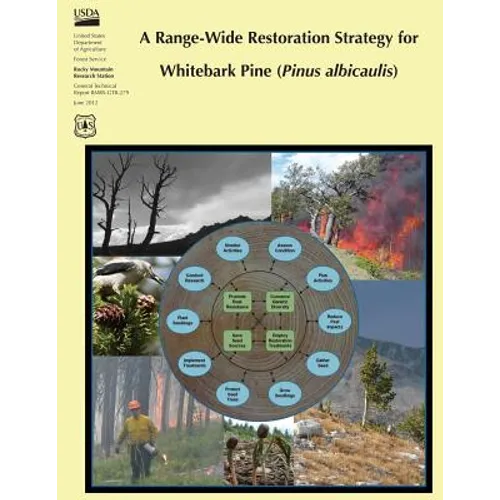
Whitebark pine (Pinus albicaulis) forests are declining across most of their range in North America because of the combined effects of mountain pine beetle (Dendroctonus ponderosae) outbreaks, fire exclusion policies, and the exotic pathogen Cronartium ribicola, which infects five-needle white pines and causes the disease white pine blister rust. The loss of this high-elevation tree species poses serious consequences for upper subalpine ecosystems, both in terms of impacts on biodiversity and losses in ecosystem processes; whitebark pine is now a candidate species for listing under the Endangered Species Act. Large, nutritious seeds produced by whitebark pine are an important food for many bird and small mammal species, as well as grizzly (Ursus arctos horribilis) and black bears (Ursus americanus), and whitebark pine communities provide habitat for many additional wildlife species. Whitebark pine seed dispersal by Clark's nutcrackers (Nucifraga columbiana) combined with hardy seedlings results in early whitebark pine community development after fire and other disturbances; whitebark pine seedlings survive on harsh, arid sites and may act as nurse trees to less hardy conifers and vegetation. Whitebark pine at higher elevations, where it is common in many regions, helps regulate snow melt and reduce soil erosion. For these collective functions, whitebark pine is considered both a keystone species for promoting community diversity and a foundation species for promoting community stability. Since more than 90 percent of whitebark pine forests exist on public land in the United States and Canada, it is important that government natural resource management agencies play an important role in ensuring future presence of this tree species by initiating concerted, coordinated, and comprehensive restoration efforts. This is best accomplished through a coordinated, trans-boundary restoration strategy that includes shared infrastructure and expertise for conserving seeds, growing blister rust-resistant seedlings, protecting trees, restoring ecosystem processes, and promoting natural regeneration. We detail a multi-scale strategy for restoring whitebark pine across its range in the western United States and Canada. The strategy was compiled by researchers, land managers, and resource specialists for use as a reference for prioritizing, designing, and implementing successful whitebark pine restoration activities across many scales from stands to landscapes to its entire range. The whitebark pine restoration strategy consists of the following principles: (1) promote rust resistance, (2) conserve genetic diversity, (3) save seed sources, and (4) employ restoration treatments. These guiding principles are then used to implement the whitebark pine restoration strategy using a set of possible actions: 1. assess condition, 2. plan activities, 3. reduce pest impacts, 4. gather seed, 5. grow seedlings, 6. protect seed sources, 7. implement restoration treatments, 8. plant burned areas, 9. support research, and 10. monitor activities. The strategy is also organized by six spatial scales of analysis and organization: 1. range-wide, 2. region (National Forest Region or Provincial Regions), 3. forest (National Forest, National Park, and Canadian Forest District), 4. landscape (watershed or landform), 5. stand, and 6. tree. At each scale, we present four important factors in the restoration strategy: (1) assessment, (2) restoration actions, (3) management concerns, and (4) an example. Strategic restoration plans are presented for the coarse-scale strategies, while illustrated examples are presented for the finer scales (tree, stand, and landscape).



