


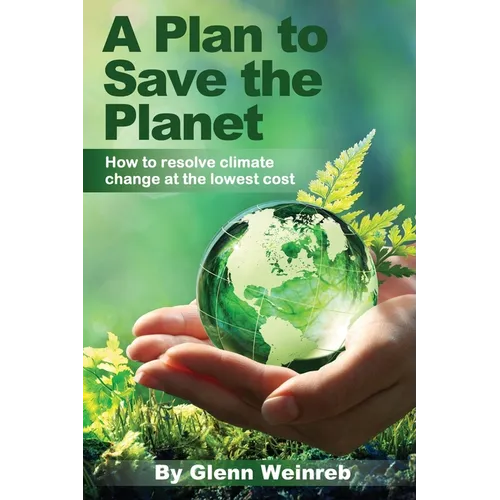
Product Description
by Glenn Weinreb (Author)
Those concerned about climate change might feel like they are stuck in a bad dream. Like being chased in the forest at 3am and unable to break free. The threat is obvious, yet little is being done. What is happening? Below is a brief summary.
- Decarbonization to zero emissions will not occur unless required by law, and this law does not exist.
- Moving this law forward would require a political coalition that benefits. For example, states that import carbon-based fuels benefit from decarbonization in two ways: (a) they gain local green jobs while carbon jobs are lost elsewhere, and (b) they save money when decarbonization causes fuel price to drop, due to less consumption.
- Past decarbonization efforts have been mild. Alternatively, to get to zero over several decades, the world would need to do massive construction at unprecedented scales. This might sound expensive; however, infrastructure is typically paid for with borrowed money. And loans are repaid with revenue generated by the infrastructure.
- Individuals, companies, cities and states are often encouraged to reduce CO2. However, they rarely have the physical ability to do so at low cost. This is mostly due to overhead costs at each "small" project.
- Power companies can decarbonize electricity at massive scales and at low costs. However, this will not occur unless required by law.
- The fossil fuel industries and their friends oppose decarbonization legislation by spending money on lobbyists and donations. However, the largest obstacle seems to be the failure of government leaders to realize they are led by domestic manufacturers who are focused on their own financial interests, not getting to zero at the lowest cost.
- To fix this, we need: (a) websites that calculate the cost and impact of proposed decarbonization law, (b) more resources that explain how to tackle climate change at the lowest cost, and (c) multiple R&D moonshots.
To read this book for free or watch a 10 minute TEDx video summary, visit APlanToSaveThePlanet.org
Number of Pages: 168
Dimensions: 0.36 x 9 x 6 IN
Publication Date: December 05, 2022



