


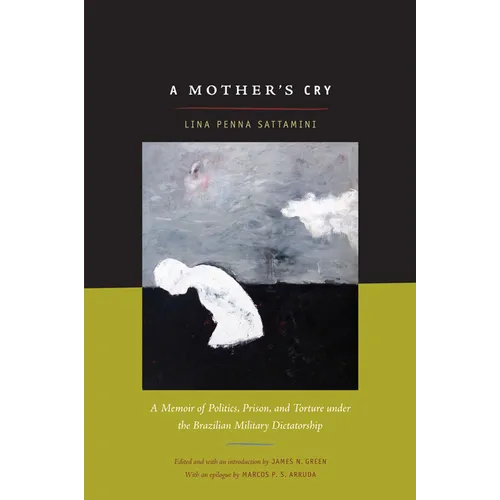
Product Description
by Lina Sattamini (Author)
During the late 1960s and early 1970s, Brazil's dictatorship arrested, tortured, and interrogated many people it suspected of subversion; hundreds of those arrested were killed in prison. In May 1970, Marcos P. S. Arruda, a young political activist, was seized in São Paulo, imprisoned, and tortured. A Mother's Cry is the harrowing story of Marcos's incarceration and his family's efforts to locate him and obtain his release. Marcos's mother, Lina Penna Sattamini, was living in the United States and working for the U.S. State Department when her son was captured. After learning of his arrest, she and her family mobilized every resource and contact to discover where he was being held, and then they launched an equally intense effort to have him released. Marcos was freed from prison in 1971. Fearing that he would be arrested and tortured again, he left the country, beginning eight years of exile.
Lina Penna Sattamini describes her son's tribulations through letters exchanged among family members, including Marcos, during the year that he was imprisoned. Her narrative is enhanced by Marcos's account of his arrest, imprisonment, and torture. James N. Green's introduction provides an overview of the political situation in Brazil, and Latin America more broadly, during that tumultuous era. In the 1990s, some Brazilians began to suggest that it would be best to forget the trauma of that era and move on. Lina Penna Sattamini wrote her memoir as a protest against historical amnesia. First published in Brazil in 2000, A Mother's Cry is testimonial literature at its best. It conveys the experiences of a family united by love and determination during years of political repression.
Back Jacket
A family's chance descent into the indignities of Brazil's military dictatorship is uncompromisingly recorded in nearly a decade of letters penned across continents; so too is the inextinguishable hope to set free a son, grandson, and brother. Arbitrarily imprisoned, brutally tortured, and subsequently whisked abroad to safety, Marcos P. S. Arruda would then face years of difficult rehabilitation. His is the tale of many a political prisoner; but, fortunate to escape with his life, he has ever since borne witness against the oppression, corruption, and brutality of authoritarian regimes, their supporters, and their protectors the world over.--Ralph Della Cava, Columbia University
Author Biography
Lina Penna Sattamini, a former freelance interpreter with the U.S. State Department, lives in Rio de Janeiro.
James N. Green is Professor of Brazilian History and Culture at Brown University.



