


Product Description
by Leandro Prados de La Escosura (Author)
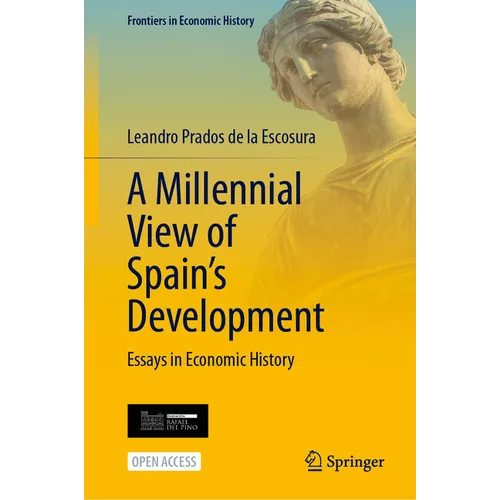
This open access book presents the evolution of the Spanish economy over the past seven centuries since the end of the Reconquest and examines how much economic progress has Spain achieved, as well as its impact on living standards and income distribution over the very long run. It shows that preindustrial Spain was far from stagnant, although levels of output per head in the early nineteenth century were not much different from those on the eve of the Black Death (1348). It further discusses how phases of simultaneous per capita output and population expansion and shrinkage alternated, lending support to the recurring growth and frontier economy hypotheses.
While a collapse in the 1570s gave way to sluggish growth and higher inequality after a long phase of sustained growth and lower inequality, the book shows how real per capita income has improved substantially over the last two centuries, driven by increased labor productivity, and derived from more intense andefficient use of physical and human capital per worker. Presenting exposure to international competition as a stimulus for this development, the book sheds light on the underperformance of Spain up to 1950 in a European comparison and describes the catch-up of Spain's economy with more advanced countries until 2007. Finally, the book explains how modern economic growth is associated with an increase in the material well-being of its inhabitants, as the most dynamic economic phases of the last century have been associated with an improvement in income distribution, although the relationship between growth and inequality has not been linear.
This book is a must-read for students, researchers, and scholars of economics and economic history interested in a better understanding of cliometrics, long-run analyses, economic development, economic growth, as well as the Spanish economy.
Back Jacket
This open access book presents the evolution of the Spanish economy over the past seven centuries since the end of the Reconquest and examines how much economic progress has Spain achieved, as well as its impact on living standards and income distribution over the very long run. It shows that preindustrial Spain was far from stagnant, although levels of output per head in the early nineteenth century were not much different from those on the eve of the Black Death (1348). It further discusses how phases of simultaneous per capita output and population expansion and shrinkage alternated, lending support to the recurring growth and frontier economy hypotheses.
While a collapse in the 1570s gave way to sluggish growth and higher inequality after a long phase of sustained growth and lower inequality, the book shows how real per capita income has improved substantially over the last two centuries, driven by increased labor productivity, and derived from more intense andefficient use of physical and human capital per worker. Presenting exposure to international competition as a stimulus for this development, the book sheds light on the underperformance of Spain up to 1950 in a European comparison and describes the catch-up of Spain's economy with more advanced countries until 2007. Finally, the book explains how modern economic growth is associated with an increase in the material well-being of its inhabitants, as the most dynamic economic phases of the last century have been associated with an improvement in income distribution, although the relationship between growth and inequality has not been linear.
This book is a must-read for students, researchers, and scholars of economics and economic history interested in a better understanding of cliometrics, long-run analyses, economic development, economic growth, as well as the Spanish economy.
Author Biography
Leandro Prados de la Escosura is an Emeritus Professor of Economic History at Carlos III University, Madrid, Spain, and a Research Fellow at the Center for Economic and Policy Research (CEPR), London, UK. Previously, he has taught at Georgetown University (Prince of Asturias Professor), USA, and the University of California, San Diego, USA. He is currently Fundación Rafael del Pino Chair and has been the Honorary Maddison Chair, University of Groningen, the Netherlands, Leverhulme Professor at the London School of Economics (LSE), United Kingdom, and Visiting Fellow at All Souls College, Oxford UK, and the LSE, and a Jean Monnet Fellow at the European University Institute, Florence, Italy.
Prados de la Escosura served as President of the European Historical Economics Society (EHES) and as a Trustee of the Cliometric Society and EHES. He belonged to the Executive Committee of the International Economic History Association. He is an editor of the Economic History Review and a member of the Advisory Board of Cliometrica, the European Review of Economic History, Explorations in Economic History, and the Scandinavian Economic History Review. He is a former editor of Revista de Historia Económica/ Journal of Iberian and Latin American Economic History and a former associate editor of the Journal of Economic Surveys.
He is the author of Human Development and the Path to Freedom (2022, Cambridge University Press), Spanish Economic Growth, 1850-2015 (2017, Palgrave MacMillan), and the editor of Exceptionalism and Industrialisation: Britain and its European Rivals, 1688-1815 (2004, Cambridge University Press). His current research interests are economic freedom and well-being in a historical perspective and economic change and inequality in Spain in the very long run.