Skip to content
Welcome To Our Store.
100,000+ Products for Home, Medical, Office & Classroom Needs
Search
Skip to product information
1 of 1

A Living Wage: Notes of an Outsider in Nepal - Paperback

$70.11 USD
$70.11 USD
Sale Sold out
Shipping calculated at checkout.
In stock (100 units), ready to be shipped

Available Offers

Fast delivery available on most orders

Multiple secure payment options accepted

Secure checkout with
  • American Express
  • Apple Pay
  • Diners Club
  • Discover
  • Google Pay
  • Mastercard
  • PayPal
  • Shop Pay
  • Visa

Flight Range: Up to 1,000 meters (3,280 feet)

Maximum Speed: 45 kilometers per hour (28 miles per hour)

For all orders exceeding a value of 100USD shipping is offered for free.

Returns will be accepted for up to 10 days of Customer’s receipt or tracking number on unworn items. You, as a Customer, are obliged to inform us via email before you return the item.

Otherwise, standard shipping charges apply. Check out our delivery Terms & Conditions for more details.

View Product Details
Shopping cart
Product Product subtotal Quantity Price Product subtotal
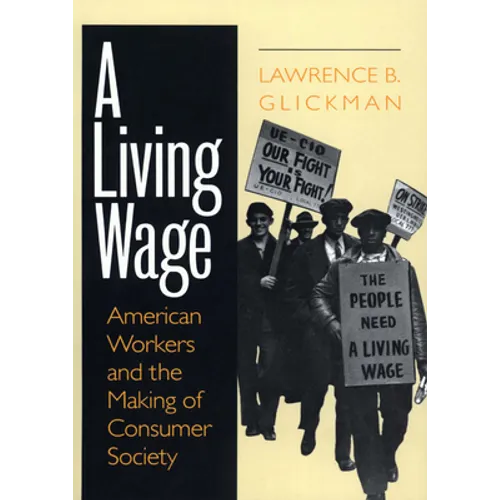
A Living Wage: Notes of an Outsider in Nepal - Paperback
$70.11/ea
$0.00
$70.11/ea $0.00

Product Description

by Lawrence B. Glickman (Author)

The fight for a "living wage" has a long and revealing history as documented here by Lawrence B. Glickman. The labor movement's response to wages shows how American workers negotiated the transition from artisan to consumer, opening up new political possibilities for organized workers and creating contradictions that continue to haunt the labor movement today.Nineteenth-century workers hoped to become self-employed artisans, rather than permanent "wage slaves." After the Civil War, however, unions redefined working-class identity in consumerist terms, and demanded a wage that would reward workers commensurate with their needs as consumers. This consumerist turn in labor ideology also led workers to struggle for shorter hours and union labels.First articulated in the 1870s, the demand for a living wage was voiced increasingly by labor leaders and reformers at the turn of the century. Glickman explores the racial, ethnic, and gender implications, as white male workers defined themselves in contrast to African Americans, women, Asians, and recent European immigrants. He shows how a historical perspective on the concept of a living wage can inform our understanding of current controversies.

Number of Pages: 240
Dimensions: 0.75 x 8.96 x 6.04 IN
Publication Date: March 09, 1999
you might like