


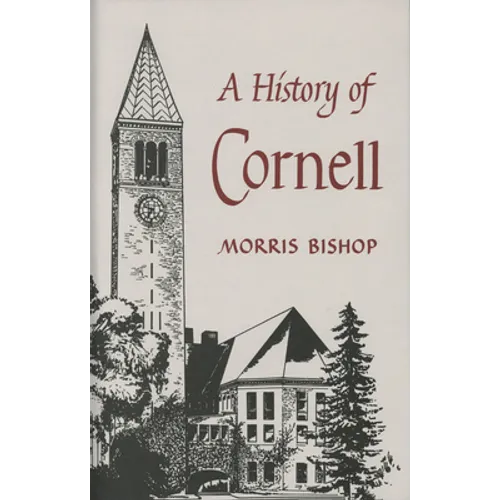
Product Description
by Morris Bishop (Author), Alison Mason Kingsbury (Illustrator)
Cornell University is fortunate to have as its historian a man of Morris Bishop's talents and devotion. As an accurate record and a work of art possessing form and personality, his book at once conveys the unique character of the early university--reflected in its vigorous founder, its first scholarly president, a brilliant and eccentric faculty, the hardy student body, and, sometimes unfortunately, its early architecture--and establishes Cornell's wider significance as a case history in the development of higher education. Cornell began in rebellion against the obscurantism of college education a century ago. Its record, claims the author, makes a social and cultural history of modern America. This story will undoubtedly entrance Cornellians; it will also charm a wider public.
Dr. Allan Nevins, historian, wrote: "I anticipated that this book would meet the sternest tests of scholarship, insight, and literary finish. I find that it not only does this, but that it has other high merits. It shows grasp of ideas and forces. It is graphic in its presentation of character and idiosyncrasy. It lights up its story by a delightful play of humor, felicitously expressed. Its emphasis on fundamentals, without pomposity or platitude, is refreshing. Perhaps most important of all, it achieves one goal that in the history of a living university is both extremely difficult and extremely valuable: it recreates the changing atmosphere of time and place. It is written, very plainly, by a man who has known and loved Cornell and Ithaca for a long time, who has steeped himself in the traditions and spirit of the institution, and who possesses the enthusiasm and skill to convey his understanding of these intangibles to the reader."
The distinct personalities of Ezra Cornell and first president Andrew Dickson White dominate the early chapters. For a vignette of the founder, see Bishop's description of "his" first buildings (Cascadilla, Morrill, McGraw, White, Sibley): "At best," he writes, "they embody the character of Ezra Cornell, grim, gray, sturdy, and economical." To the English historian, James Anthony Froude, Mr. Cornell was "the most surprising and venerable object I have seen in America." The first faculty, chosen by President White, reflected his character: "his idealism, his faith in social emancipation by education, his dislike of dogmatism, confinement, and inherited orthodoxy"; while the "romantic upstate gothic" architecture of such buildings as the President's house (now Andrew D. White Center for the Humanities), Sage Chapel, and Franklin Hall may be said to "portray the taste and Soul of Andrew Dickson White."
Other memorable characters are Louis Fuertes, the beloved naturalist; his student, Hugh Troy, who once borrowed Fuertes' rhinoceros-foot wastebasket for illicit if hilarious purposes; the more noteworthy and the more eccentric among the faculty of succeeding presidential eras; and of course Napoleon, the campus dog, whose talent for hailing streetcars brought him home safely--and alone--from the Penn game. The humor in A History of Cornell is at times kindly, at times caustic, and always illuminating.