


Product Description
by Michael Frede (Author), A. a. Long (Editor), David Sedley (Foreword by)
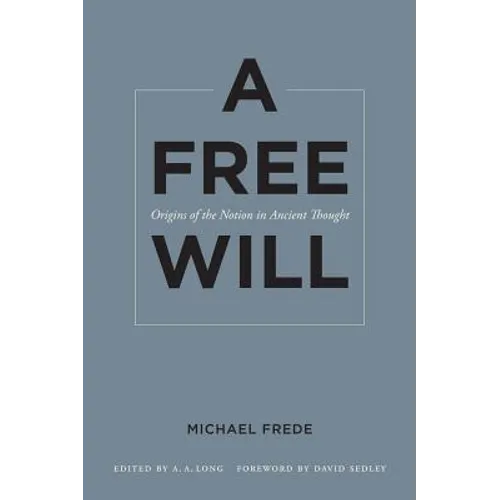
Where does the notion of free will come from? How and when did it develop, and what did that development involve? In Michael Frede's radically new account of the history of this idea, the notion of a free will emerged from powerful assumptions about the relation between divine providence, correctness of individual choice, and self-enslavement due to incorrect choice. Anchoring his discussion in Stoicism, Frede begins with Aristotle--who, he argues, had no notion of a free will--and ends with Augustine. Frede shows that Augustine, far from originating the idea (as is often claimed), derived most of his thinking about it from the Stoicism developed by Epictetus.
Front Jacket
As readers will quickly discover, the quality of the text that [Frede] has bequeathed fully matches the brilliance and incisiveness for which all his work is admired.
From the foreword by David Sedley
Author Biography
Michael Frede, who died in 2007, held positions successively in the departments of philosophy at the University of California, Berkeley, Princeton University, and Oxford University, where he held the Chair of the History of Philosophy. In 1997-1998, he was Sather Professor of Classical Literature at UC Berkeley, where he delivered the lectures that make up this volume. A. A. Long is Professor of Classics, Irving Stone Professor of Literature, and Affiliated Professor of Philosophy at the University of California, Berkeley. He is the author of Epictetus: A Stoic and Socratic Guide to Life and From Epicurus to Epictetus: Studies in Hellenistic and Roman Philosophy. David Sedley is Lawrence Professor of Ancient Philosophy at the University of Cambridge and the author of Creationism and Its Critics in Antiquity (UC Press).



