Product Description
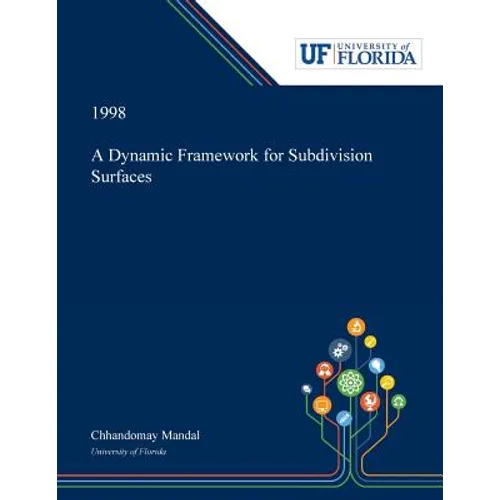
by Chhandomay Mandal (Author)
Abstract:
Subdivision surfaces are extensively used to model smooth shapes of arbitrary topology. Recursive subdivision on a user-defined initial control mesh generates a visually pleasing smooth surface in the limit. However, users have to carefully select the intiail mesh and.or manipulate the control vertex positions at different levels of subdivision hierarchy to satisfy the functional and aesthetic requirements in the smooth limit surface. This modeling drawback results fromt eh lack of direct manipulation tools for the limit surface. In this dissertation, techniques from physics-based modeling are integrated with geometric subdivision methodology, and a dynamic framework is presented for direct manipulation of the smooth limit surface generated by the subdivision schemes using physics based "force" tools. In a typical subdivision scheme, the user starts with an initial control mesh which is refined recursively using a fixed set of subdivision rules, and a smooth surface is produced in the limit. Most often this limit surface does not have an analytic expression, and hence poses challenging problems in incorporating mass and damping distribution functions, internal deformation energy, forces, and other physical quantities required to develop a physics-based subdivision surface model. In this dissertation, local parameterization techniques suitable for embedding the geometric subdivision surface model in a physics-based modeling framework have been developed. Specific local parameterization techniques have been fully developed for the Catmull-Clark, modified butterfly and the Loop subdivision schemes. Techniques for assigning material properties to geometric subdivision surfaces are derived, and a motion equation for the dynamic model has been formulated using Lagrangian dynamics. Furthermore, advantages of the physics-based deformable models are incorporated into the conventional subdivision schemes, and a dynamic hierarchical control of this model is introduced. Finally, a multiresolution representation of the control mesh is developed and a unified approach for deriving subdivision surface-based finite elements is presented. The proposed dynamic framework enhances the applicability of the subdivision surfaces in modeling applications. It is also useful for hierarchical shape recovery from large range and volume data sets, as well as for non-rigid motion tracking from a temporal sequence of data sets. Multiresolution representation of the initial mesh controlling the smooth limit surface enables global and local editing of the shape as desired by the modeler. This dynamic framework has also been used for synthesizing natural terrain models from sparse elevation data. Dissertation Discovery Company and University of Florida are dedicated to making scholarly works more discoverable and accessible throughout the world. This dissertation, "A Dynamic Framework for Subdivision Surfaces" by Chhandomay Mandal, was obtained from University of Florida and is being sold with permission from the author. A digital copy of this work may also be found in the university's institutional repository, IR@UF. The content of this dissertation has not been altered in any way. We have altered the formatting in order to facilitate the ease of printing and reading of the dissertation.
Number of Pages: 184
Dimensions: 0.39 x 11 x 8.5 IN
Publication Date: July 21, 2019