


Product Description
by Jason Monti (Author)
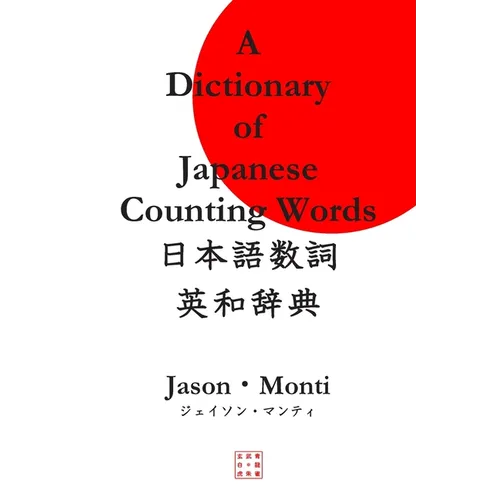
Counting is perhaps one of the most maddening aspects of Japanese grammar for learners of the language.This is because there is no simple, systematic way of doing so in Japanese like there is in English. After all, if you want to count dogs in English, simply put the appropriate number in front of the word "dog" and add the enclitic "s" to it: five dogs, for example. You can do this with any count noun in English. In order to count individual parts of non-count nouns in English, pick an appropriate measure and count those instead: five drops of water. However, Japanese treats all nouns the same way English treats water, and everything has its own, special counting word, or counter, that attaches to the number in order to count the nouns. There are well over five hundred of these, but most Japanese use only about fifty of them in everyday conversation. Some of them are extremely broad in meaning, such as "hon", which covers long, cylindrical objects, ranging from trains to pencils to bottles. Others are less general, but still cover a broad range of things, such as "hiki", which covers most animals. Some, however, are highly specific (and obscure), such as "rin", which one uses to count fish scales.If this were not hard enough, each counter combines with numerals in different ways, causing changes in pronunciation based on the first sound of the counter and the last sound of the numeral: "ichi" + "kai" becomes "ikkai", not "ichikai", as one might expect.This book will serve as a reference tool for anyone who speaks or writes Japanese, from students to researchers to translators. Each counter has its own page that details how the counter interacts with numbers one through ten as well as other irregular versions. Many entries include extra notes that add context and interesting historical trivia that explains usage development.An extensive Index of English Meanings assists the reader in locating appropriate counters.
Author Biography
Jason Monti earned his first bachelor's degree in Japanese Language and Literatures with a minor in Asian Studies from the University of Florida. He spent his final year of university at Kansai Foreign Language University in Hirakata City, Osaka Urban Prefecture, Japan, on an exchange program. After graduation, he taught English in Ibara City and Bisei Town, Okayama Prefecture, Japan for three years on the Japan Exchange and Teaching (JET) Programme. He has also traveled extensively throughout Japan, and currently lives and works in Fukui Prefecture.



