Product Description
by Eckhard Platen (Author), David Heath (Author)
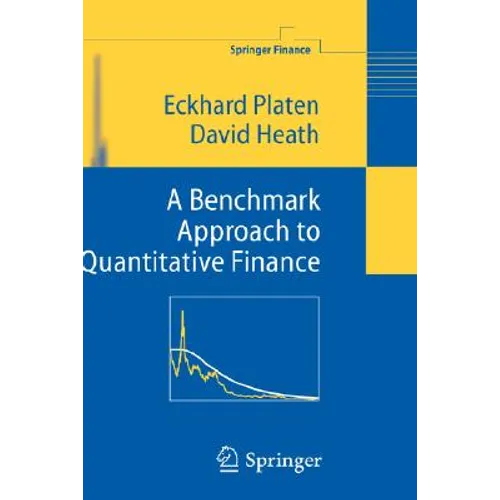
The benchmark approach is a framework for financial market modeling that extends beyond standard risk neutral pricing theory. It permits a unified treatment of portfolio optimization, derivative pricing, integrated risk management and insurance risk modeling. The first part of this book describes the necessary tools from probability theory, statistics, stochastic calculus and the theory of stochastic differential equations with jumps. The second part is devoted to financial modeling under the benchmark approach, explaining various quantitative methods for the fair pricing and hedging of derivatives. It aims to be a self-contained, accessible but mathematically rigorous introduction to quantitative finance for readers having a reasonable mathematical or quantitative background. Finally, the book should stimulate interest in the benchmark approach by describing some of its power and wide applicability. A Benchmark Approach to Quantitative Finance is intended for a wide audience including quantitative analysts, postgraduate students and practitioners in finance, economics and insurance.
Back Jacket
The benchmark approach provides a general framework for financial market modeling, which extends beyond the standard risk neutral pricing theory. It permits a unified treatment of portfolio optimization, derivative pricing, integrated risk management and insurance risk modeling. The existence of an equivalent risk-neutral pricing measure is not required. Instead, it leads to pricing formulae with respect to the real world probability measure. This yields important modeling freedom which turns out to be necessary for the derivation of realistic, parsimonious market models. The first part of the book describes the necessary tools from probability theory, statistics, stochastic calculus and the theory of stochastic differential equations with jumps. The second part is devoted to financial modeling under the benchmark approach. Various quantitative methods for the fair pricing and hedging of derivatives are explained. The general framework is used to provide an understanding of the nature of stochastic volatility. The book is intended for a wide audience that includes quantitative analysts, postgraduate students and practitioners in finance, economics and insurance. It aims to be a self-contained, accessible but mathematically rigorous introduction to quantitative finance for readers that have a reasonable mathematical or quantitative background. Finally, the book should stimulate interest in the benchmark approach by describing some of its power and wide applicability.
Author Biography
Professor Eckhard Platen is a joint appointment between the School of Finance and Economics and the Department of Mathematical Sciences to the 1997 created Chair in Quantitative Finance at the University of Technology Sydney. Prior to this appointment he was Founding Head of the Centre for Financial Mathematics at the Institute of Advanced Studies at the Australian National University in Canberra. He completed a PhD in Mathematics at the Technical University in Dresden in 1975 and obtained in 1985 his Dr. sc. from the Academy of Sciences in Berlin, where he headed at the Weierstrass Institute the Sector of Stochastics.
He is co-author of two successful books on Numerical Methods for Stochastic Differential Equations, published by Springer Verlag, and has authored more than 100 research papers in quantitative finance and mathematics.
Dr David Heath works as a Senior Research Fellow in Quantitative Finance at the University of Technology, Sydney. During the early 1990s he became interested in various aspects of quantitative finance. He completed his PhD in financial mathematics at the Australian National University at the Centre for Financial Mathematics in 1995. Since this time his main research interests have focussed on the application of advanced numerical methods for the pricing and hedging of index, equity, FX and interest rate derivatives. These numerical methods include PDE, Monte Carlo and Markov chain methods. He has developed a range of new quantitative methods that are specifically designed for the benchmark approach. Dr Heath has authored more than thirteen publications in financial mathematics.