


Product Description
by Andrew P. Livera (Author)
Want to learn more Korean words? Don't worry
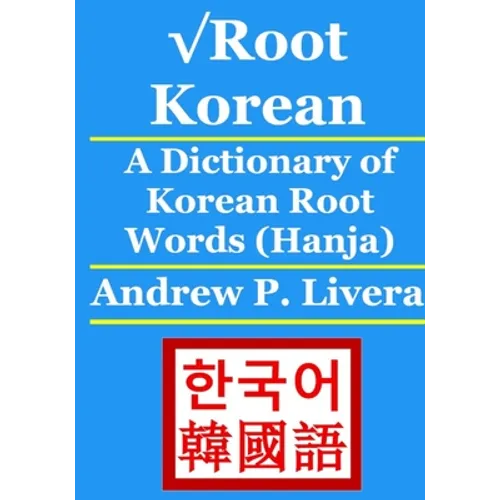
√Root Korean: A Dictionary of Korean Root Words (Hanja) is here to help YOU How will this book help me learn Korean? This book is a Chinese-English-Korean dictionary. If you want to know what the word 입구 means, you can search for its components (입 and 구) in this book. When you search for the word 입, you'll find that one of its possible meanings is 入 (enter). When you search for the word 구, you'll find that one of its possible meanings is 口 (opening). Together, 입 and 구 form the word for 'entrance' which is 입구 (入口). You've just learned two Hanja Wait, what are 'Hanja'? Hanja are borrowed Chinese characters with Korean pronunciation. They are to Korean as Latin is to English. For example, the Hanja 書 means 'book' and it's pronounced as 서. Why should I learn the Hanja? 1. You can use Hanja to clarify a homonym● For example, the word 눈 could mean 'eye' or 'snow.'
○ Write 눈 as 눈(目) when you mean 'eye.'
○ Write 눈 as 눈(雪) when you mean 'snow.' 2. You might see Hanja in a newspaper
● A Korean word may be written in Hanja instead of Korean in a formal newspaper article.
○ For example, the city Busan (부산) might be written as 釜山 in a formal newspaper article. 3. Some Hanja appear in multiple words
● For example, 電/전/lightning appears in the words
○ Electricity/전기/電氣
○ Battery/전지/電池
○ Electrician/전공/電工 I'm ready to learn the Hanja How do I learn them? Buy √Root Korean: A Dictionary of Korean Root Words (Hanja) NOW Does this book contain monosyllabic or polysyllabic Hanja? √Root Korean: A Dictionary of Korean Root Words (Hanja) only contains monosyllabic Hanja like 'book'/서/書. This book does not contain polysyllabic Hanja like 'to exit'/입구/入口.
Number of Pages: 826
Dimensions: 1.64 x 10 x 7 IN
Publication Date: August 09, 2018