Skip to content
Save 5% on your next order with code PREMIUM5!
100,000+ Products for Home, Medical, Office & Classroom Needs
Search
Skip to product information
1 of 1

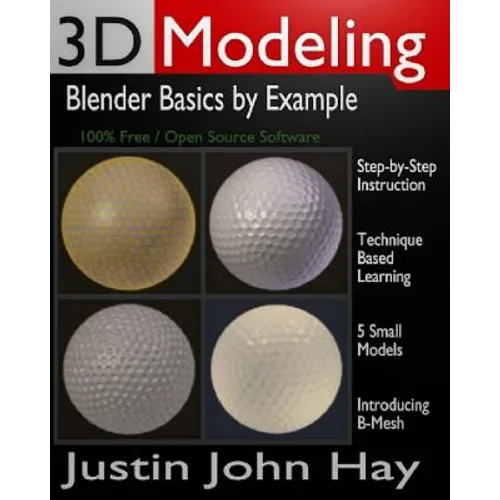
3D Modeling: Blender Basics by Example - Paperback

$63.45 USD
$63.45 USD
Sale Sold out
Shipping calculated at checkout.
In stock (100 units), ready to be shipped

Available Offers

Fast delivery available on most orders

Multiple secure payment options accepted

Secure checkout with
  • American Express
  • Apple Pay
  • Diners Club
  • Discover
  • Google Pay
  • Mastercard
  • PayPal
  • Shop Pay
  • Visa

Flight Range: Up to 1,000 meters (3,280 feet)

Maximum Speed: 45 kilometers per hour (28 miles per hour)

For all orders exceeding a value of 100USD shipping is offered for free.

Returns will be accepted for up to 10 days of Customer’s receipt or tracking number on unworn items. You, as a Customer, are obliged to inform us via email before you return the item.

Otherwise, standard shipping charges apply. Check out our delivery Terms & Conditions for more details.

View Product Details
Shopping cart
Product Product subtotal Quantity Price Product subtotal
3D Modeling: Blender Basics by Example - Paperback
$63.45/ea
$0.00
$63.45/ea $0.00

Product Description

by Justin John Hay (Author)

Blender is a robust 3D modeling program which is both free and open source. Three dimensional meshes, animations, and even video games are possible. Blender is a fully packed, feature rich 3d suite. Considering Blender's free status, it is a stunning example of what can be accomplished with open source software. With the Blender builds becoming increasingly feature packed, volume related problems with teaching, and more importantly, with learning are becoming evident. This work serves to bypass the problem at hand. Only the very core modeling techniques are shown; all else is forsaken. Topics such as advanced texturing, the new Cycles rendering engine, nodes, and the like, are purposefully sidestepped. This is done in an effort to avoid burnout and get modelers off the ground within a few weeks. The teaching style relies on small technique based examples, for which readers are to work through and replicate. Full models are not used to demonstrate technique, -this alone speeds the learning process considerably. At the end of the book, 5 small, but complete models are given with step-by-step instruction. This allows for a small period, whereby modelers are essentially using training-wheels while transferring from 'technique understanding' to 'full on' model development.

Number of Pages: 246
Dimensions: 0.64 x 10 x 8 IN
Publication Date: August 07, 2012
you might like