


Product Description
by Chris Maser (Author), Andrew W. Claridge (Author), James M. Trappe (Author)
In today's world of specialization, people are attempting to protect the Earth's fragile state by swapping limousines for hybrids and pesticide-laced foods for organic produce. At other times, environmental awareness is translated into public relations gimmicks or trendy commodities. Moreover, simplistic policies, like single-species protection or planting ten trees for every tree cut down, are touted as bureaucratic or industrial panaceas.
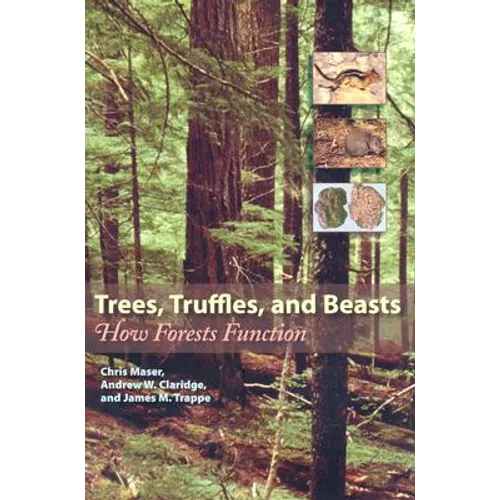
Because today's decisions are tomorrow's consequences, every small effort makes a difference, but a broader understanding of our environmental problems is necessary to the development of sustainable ecosystem policies. In Trees, Truffles, and Beasts, Chris Maser, Andrew W. Claridge, and James M. Trappe make a compelling case that we must first understand the complexity and interdependency of species and habitats from the microscopic level to the gigantic. Comparing forests in the Pacific Northwestern United States and Southeastern mainland of Australia, the authors show how easily observable species, trees and mammals are part of a complicated infrastructure that includes fungi, lichens, and organisms invisible to the naked eye, such as microbes. Eminently readable, this important book shows that forests are far more complicated than most of us might think, which means simplistic policies will not save them. Understanding the biophysical intricacies of our life-support systems just might.Author Biography
Chris Maser is a writer, environmental consultant, and master's level zoologist who has written over twenty books, including Mammals of the Pacific Northwest and Forest Primeval: The Natural History of an Ancient Forest.
Andrew W. Claridge is a research scientist with the Department of Environment and Conservation in New South Wales, Australia. He has authored or co-authored over fifty publications about the interactions among trees, truffles, and animals and undertaken research at postgraduate and postdoctoral levels in both Australia and the United States of America. James M. Trappe is a professor of forest science specializing in forest fungi at Oregon State University, Corvallis, and the author of almost four hundred journal articles and book chapters.
Number of Pages: 280
Dimensions: 0.8 x 9.1 x 6.1 IN
Illustrated: Yes
Publication Date: December 01, 2007


