


Product Description
by Clinton L. Holt (Author)
Clint has discovered something no more advanced than third grade arithmetic.
This new discovery could lead to new engineering applications; or lead to the creation of a one-world bank, one-world credit system, or one-world inventory. Could you imagine being able to keep track of everything in one program?
What the author has found could even lead to the creation of a three-dimensional computer memory that could operate at virtually infinite speeds - or it could lead to the discovery of even more mathematical findings.
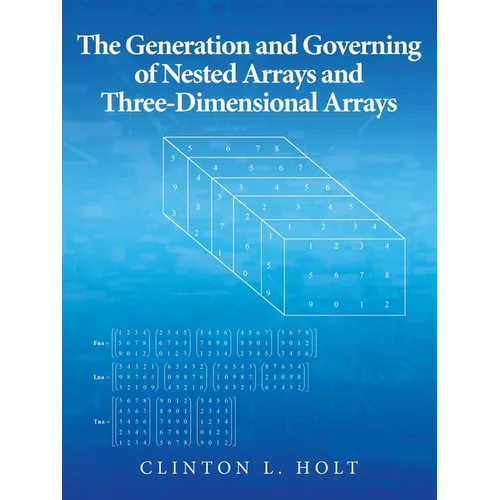
The discovery, which he outlines in detail in this book, shows that when we derive a nested array, we can not only sum the columns (which is regular matrix multiplication that we already know), we can also sum the rows of the sub-matrices and sum the sub-matrices themselves. That is just the beginning.
In this book, he reveals what he's found - something that he first reported to the American Mathematical Society more than twenty years ago but was ignored, not understood or suppressed. With this book he hopes you make up your own minds.
He offers 9 valid m+1, n+1 Proofs. Statistical examples are entire chapters reduced to single lines of programming. Accounting, Inventories and Statistics are ruled by a single set of three basic equations. n(A x B) = C; n( A B ) = C and n( AT o B ) =C. We look at them in 0-D and all three reduce to A x B = C. You know the first two equations, the third generates 3-D Arrays. The third is the new Operator we will explore in this book.


