


PRODUCT DESCRIPTION
by Wassily Kandinsky (Author), Howard Dearstyne (Translator)
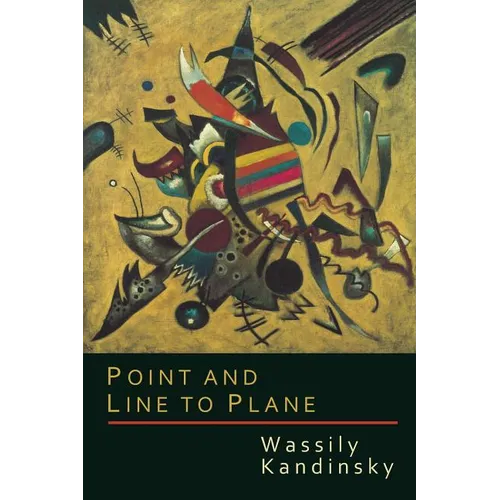
2013 Reprint of 1947 Edition. Exact facsimile of the original edition, not reproduced with Optical Recognition Software. In this title Kandinsky analyzed the geometrical elements which make up every painting-the point and the line. He called the physical support and the material surface on which the artist draws or paints the basic plane, or BP. He did not analyze them objectively, but from the point of view of their inner effect on the observer. A point is a small bit of color put by the artist on the canvas. It is neither a geometric point nor a mathematical abstraction; it is extension, form and color. This form can be a square, a triangle, a circle, a star or something more complex. The point is the most concise form but, according to its placement on the basic plane, it will take a different tonality. It can be isolated or resonate with other points or lines. A line is the product of a force which has been applied in a given direction: the force exerted on the pencil or paintbrush by the artist. The produced linear forms may be of several types: a straight line, which results from a unique force applied in a single direction; an angular line, resulting from the alternation of two forces in different directions, or a curved (or wave-like) line, produced by the effect of two forces acting simultaneously. The book contains many photographic examples and drawings from Kandinsky's works which offer the demonstration of its theoretical observations, and which allow the reader to experience the inner effect of the point and line to plane.


