


Product Description
by Muhammad Akram (Author), Musavarah Sarwar (Author), Wieslaw A. Dudek (Author)
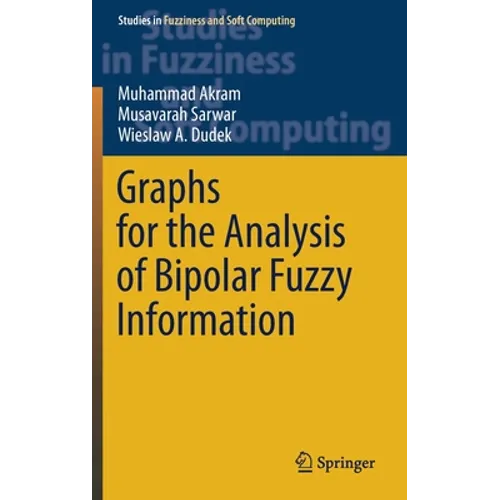
This monograph discusses decision making methods under bipolar fuzzy graphical models with the aim of overcoming the lack of mathematical approach towards bipolar information-positive and negative. It investigates the properties of bipolar fuzzy graphs, their distance functions, and concept of their isomorphism. It presents certain notions, including irregular bipolar fuzzy graphs, domination in bipolar fuzzy graphs, bipolar fuzzy circuits, energy in bipolar fuzzy graphs, bipolar single-valued neutrosophic competition graphs, and bipolar neutrosophic graph structures. This book also presents the applications of mentioned concepts to real-world problems in areas of product manufacturing, international relations, psychology, global terrorism and more, making it valuable for researchers, computer scientists, social scientists and alike.
Back Jacket
This monograph discusses decision making methods under bipolar fuzzy graphical models with the aim of overcoming the lack of mathematical approach towards bipolar information--positive and negative. It investigates the properties of bipolar fuzzy graphs, their distance functions, and concept of their isomorphism. It presents certain notions, including irregular bipolar fuzzy graphs, domination in bipolar fuzzy graphs, bipolar fuzzy circuits, energy in bipolar fuzzy graphs, bipolar single-valued neutrosophic competition graphs, and bipolar neutrosophic graph structures. This book also presents the applications of mentioned concepts to real-world problems in areas of product manufacturing, international relations, psychology, global terrorism and more, making it valuable for researchers, computer scientists, social scientists and alike.
Author Biography
MUHAMMAD AKRAM is Professor at the Department of Mathematics, University of the Punjab, Lahore, Pakistan. He previously served at Punjab University College of Information Technology as Assistant Professor and Associate Professor. He earned his Ph.D. in Fuzzy Mathematics from Government College University, Lahore, Pakistan. His research interests include numerical algorithms, fuzzy graphs, fuzzy algebras, and fuzzy decision support systems. He has published 09 books and over 365 research articles in peer-reviewed international journals and supervised 12 Ph.D. students.