


Product Description
by Lukas M. Verburgt (Editor)
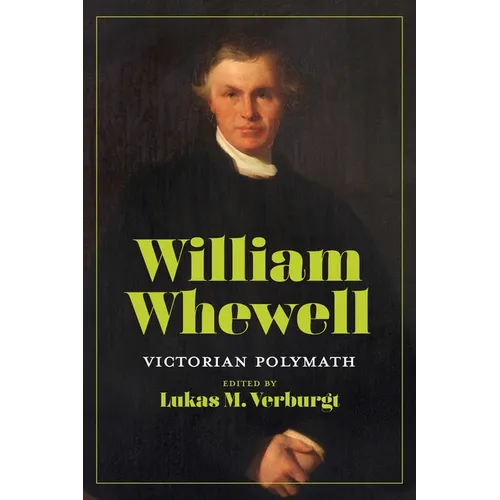
William Whewell, the famous master of Trinity College in Cambridge, was a central figure in nineteenth-century British scientific culture and one of the last great polymaths. His influential work ranged from history and philosophy of science, education, architecture, mineralogy, and political economy to mathematics, engineering, natural theology, metaphysics, and moral philosophy. Among his many gifts to science was his role as cofounder and president of the British Association for the Advancement of Science and his wordsmithing; he coined the terms scientist, physicist, linguistics, and electrode. While he was himself an opponent of evolution through natural selection, Whewell's most famous works, including his Bridgewater Treatise (1833) and Philosophy of the Inductive Sciences (1840), played a formative role in Charles Darwin's creation of the theory of evolution. William Whewell: Victorian Polymath reexamines the whole of Whewell's oeuvre, as well as the wide range and internal unity of his many polymathic endeavors, placing him within the early Victorian intellectual landscape and highlighting his exchanges with other important figures of the period, such as John Herschel, Charles Lyell, and Robert Peel. Bringing together a group of eminent and emergent scholars, the volume explores all major aspects of Whewell's reform project and its legacy, both in the sciences and the humanities, in the Victorian era and beyond.


